Declaration of Love

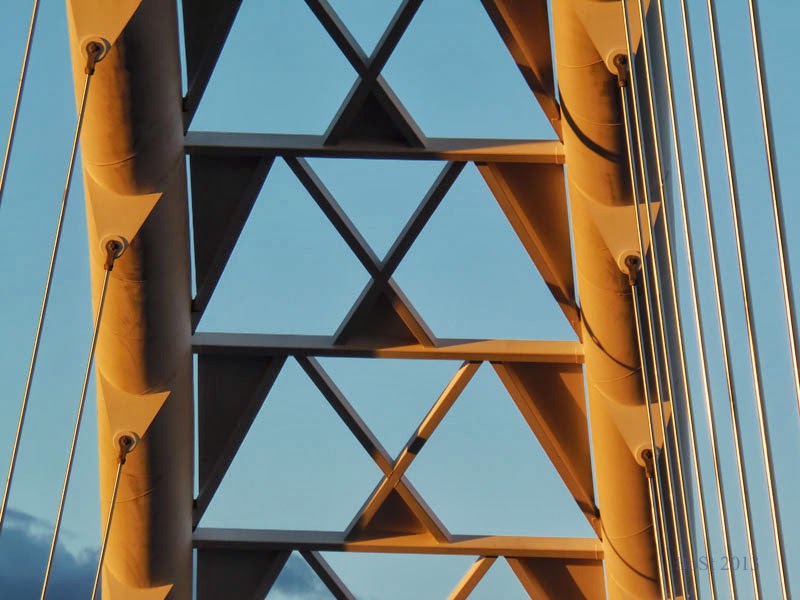
There is a white bridge at the mouth of the Humber River where it joins Lake Ontario. The bridge is designed to resemble the belly of a snake, with tortoises embedded in the walls at both ends of the strong steel and concrete structure that, in the center of its belly, seems to reach the sky. As you traverse this span from Etobicoke to Toronto, whether you are a jogger, roller-skater, bicycler, dog walker or simply having a leisurely stroll, you can gaze from the bridge over a magnificent view of the city, the expansive lake, the snaking shoreline or stretch your neck to look above at the lattice work. There you will see a pattern that resembles the scales and skeleton of a snake, making you feel as though you are walking in the middle of its belly. Another delightful surprise awaits you at both ends if you look down to the bridge foundations, where you will note a very prominent inlay of a white snake. These telltale signs lead me to speculate that the architect had the classic story of the Lady White in mind.


For those of you who are not familiar with this legendary tale I shall briefly retell this popular love story.
A long time ago in the middle of a lake there was a white snake spirit who diligently practiced Taoist magical arts in the hope of becoming an immortal. Chancing on immortality pills that had been regurgitated by the boy Xu Xian, the white snake at once swallowed them and was instantly transformed and gained 500 years worth of magical powers. As an Immortal, the white snake found she could quite easily assume human form.
In the same lake meanwhile there had been a tortoise spirit who had also aspired to immortality. Having failed to consume any of the discarded pills, from that day hence he harboured a deep seated resentment for the white snake, blaming her for all his subsequent tribulations.
One day on the bridge the white snake observed a beggar who had just caught a green snake and was about to slice out its gallbladder to sell it. The poor green snake was crying and pleading for mercy to the deaf ears of the human. Filled with sympathy, the white snake at once transformed into a woman and, walking across the bridge, accosted the beggar. After an exchange of polite words she offered to buy the green snake alive, saving the green snake from being sliced alive. The grateful green snake from then on adopted the white snake as her elder sister.
Some 18 years later during the Qingming Festival the white snake and her green snake sister, very much intrigued by humans’ endeavors and yearning to experience humans’ joys, transformed themselves into two young ladies. Flying on clouds, they reached Hangzhou in no time at all and discreetly blended in with the crowd to enjoy the festivities. The White and Green snakes were so enthralled by the beauty of the surroundings that they quickly forgot themselves, throwing all caution aside. West Lake lies beside the city of Hangzhou and, bordered by lush green hills, has always been renowned for its breathtaking scenery drawing many scholars or noted visitors who loved to stroll its banks or take boats across the water.
As luck would have it, there at the Broken Bridge, these two ladies chanced on Xu Xian. When the capricious sun took refuge behind some clouds and rain fell, the two ladies had sought shelter under the willow tree without much success. Xu, by then a handsome and gallant young scholar, saw the ladies in dire straits and offered them his umbrella at once. As Lady White insisted on Xu sharing the umbrella with them the two, during their conversation, had quietly fallen in love. Destiny had played a hand to draw these two lovers together.
Meanwhile Lady White had learned that the scholar was simply returning from a visit to his mother’s grave. He had been orphaned when young and presently lived with his sister and her husband, earning a scant living as an assistant in their herbal medicine shop.
To make the long story short, Lady White (or Bai Suzhen as she’d introduced herself to the scholar), throwing all caution to the wind, married the scholar Xu Xian. The happy couple then moved to Zhenjiang and there, with the sizeable funds from her supposed inheritance, opened a medicine shop of their own. Utilizing her extensive knowledge of various herbal medicines they were able to successfully cure many ailments, and before long the business prospered. Lady White especially was much beloved because of her dedication to helping the sick, no matter how poor they were.
Oh, but oh so fickle is fate; for the terrapin spirit that once dwelled in the same lake as Bai Suzhen had, by this time, accumulated enough powers to take on a human form and had transformed into a Buddhist monk called Fahai who, without much success, also dabbled in the healing arts. He learned about the brilliance of Bai Suzhen and, to his chagrin, discovered that she is his old nemesis Lady White. He was further consumed by jealousy when he found out about her blissful existence and from then on plotted to break up her relationship with Xu Xian. He visited their shop and, finding an opportunity, discretely approached Xu Xian when Bai Suzhen, by then an expectant mother, went off for a brief respite leaving her husband to tend to customers.
“I’m Fahai, the Abbot of Gold Mountain Temple,” the disguised turtle introduced himself to Xu in a conspiratorial whisper. “I have come here, under this pretext, to warn you of the great peril you are in. Through my spiritual guide, I have discovered that your wife is in fact, a thousand-year-old snake. Heed my words young man, for now she hides well her true nature, but one day she will surely turn on you, as all demons do, and devour you!”
“How dare you say such a thing?” protested Xu. “My wife is an angel, what you say is nothing short of a wicked slander!”
“Fine, fine; don’t take my word for it.” Fa shaking an index finger, sternly admonished Xu. He next pretended to storm out the door but, as if on a second thought, he halted and, half turning, said, “Before long the Duanwu Festival will be here. Offer her realgar wine, if she does not revert back to her true form, then I, in advance, offer my apologies.”
At the Duanwu festival, according to an old custom, everyone would liberally partake of wine mixed with foul-smelling realgar to supposedly to drive away snakes or evil spirits.
To escape disclosure and wary of the possible dangers, Lady White had feigned illness during the Duanwi Festival. She insisted on keeping to her bed but encouraged her husband to go out and partake of the festivities, while Xiaoqing (Green Snake) tended to her needs. That might have been the end of that but unfortunately, however, the devoted Xu refused to leave her side and, desiring her to be especially safe, he further insisted that she drink some measure of the realgar concoction. When she adamantly refused and offered only feeble excuses Fahai’s dire warnings rushed to Xu’s mind. His demeanor darkened but then just as quickly he dismissed it all with a wave of his hand. When his wife inquired as to the reason for his odd behaviour, Xu simply shrugged and related the warning words of Fahai, thinking it to be nothing other than a poor joke.
Bai could not conceal her terror and her face grew visibly pallid. The wave of suspicion that grazed his eyes, though briefly, wrenched Bai’s heart. Hoping that her accrued powers were strong enough to withstand the danger she dismissed Xiaoping and requested a cup of reagal wine from her husband. Receiving it, she quickly downed it. As further reassurance she pretended to like it and asked for more, but before she could finish the third, she began to retch violently. She was helped to her bed by her most concerned and apologetic husband who then rushed out the door to fetch her some medicine. When he returned, he found, instead of his wife, a giant white snake coiled on the bed. The shock was too great for Xu Xian to bear and he instantly collapsed dead onto the floor.
Later, when Bai reverted back to human form, Xiaoping told her the result of Bai’s reckless act; how she had discovered Xu’s corpse. Grief-stricken, Bai knelt by her husband and wept and wept.
Eventually setting aside her grief, Bai Suzhen (Lady White) and Xiaoqing (Green Snake) traveled to Mount Emei, where they braved countless dangers to steal a magical herb. Ingesting the drink made from this magic mushroom, Xu Xian was swiftly restored back to life. But though he’d fully recovered a strange alienation dogged their marriage. Inwardly terrified that his wife was not human, and being ignorant of her heroic efforts to save his life, Xu from then on shunned any intimacy with Bai.
Desperate to regain his affections, Bai one day played a rather ingenious ruse on her husband. Her white silk sash was turned to a living snake and, with this as a plausible explanation; Xu was led to believe that the scarf was what had frightened him. Subsequently, their marital bliss returned until Xu decided to visit Gold Mountain Temple to express his gratitude to Buddha for their present happiness.
On his way Xu encountered Fahai along the banks of the river. Latter still adamant about his dire warnings, Fahai again planted the seed of suspicion in Xu’s heart, hinting that his wife was not above playing dirty tricks on him. Terrified, Xu was then given a possible solution to his dilemma: “Become a monk and live at the temple; that’s one place the demon that is your wife, won’t be able to reach you.”
At first Xu Xian had remained reticent, as he’d been torn between the love he felt for his wife and the fear of her. Subsequently, with his head and his heart still at war; his ambivalence seemingly eternal, he decided to defer any decision till later and, on the urging of Fahai, boarded the raft. Together they crossed over to the river island where the Gold Mountain temple was built. Once inside however Xu found himself virtually imprisoned.
“This is for your own good. You should be thanking me for saving your life,” Insisted Fahai as he turned the key to Xu’s cell door.
Three days passed and Xu had not returned. By then Bai was worried and anticipating the grievous outcome, she shared her intentions with her sister Xiaoqing. On the following day they both armed themselves with swords and set off on the rescue mission. Unfortunately Fahai had predicted this move and awaited them at the temple gate with sizeable force.
At first, Bai tried diplomacy, but no amount of pleading or threats would persuade Fahai to release Xu.
“Vile Demon!” Fahai, grinding his teeth, bellowed. “You cannot feast on this human. It is my solemn duty to protect unsuspecting humans from one such as you!”
“I have harmed no one and helped many,” protested Lady White. “Surely the demon is he who divides man and wife!”
“Save your breath sister, he won’t listen to any reason!” Xiaoqinq interceded. “Force is our only recourse; nothing short of violence will get through that thick skull of his!”
Constrained by circumstances, the lovely and courageous Bai Suzhen and Xiaoqing fought a fierce battle with Fahai and his group for many a day. Despondent, Bai used her powers to flood the temple, with dire consequences, as many innocents drowned.
Yet Bai Suzhen's pregnancy had impaired her powers. In the end she was forced to admit defeat and forced to flee to safety and fight another day.
From within the temple cell meanwhile, Xu had heard all that seemingly endless commotion of the battle. Upon discovering that it was his wife’s attempt at his rescue he became adamant to at least to stand by her. Using his wits he eventually succeeded in escaping from Jinshan Temple and, at long last finding her, both disclosed the truth in a lengthy, breathless, talk.
“I now understand how you’ve suffered for my sake.” Xu hugged his wife in the end. “Human or not, I shall love you for all eternity. “
The reunited lovers then move to Hangzhou, where Bai Suzhen gave birth to a son, Xu Mengjiao. Once more their happiness would have been boundless had it not been for their adamant foe Fahai who, unfortunately, again hunted them down and, after defeating Bai Suzhen, imprisoned her permanently in Leifeng Pagoda.
Fahai’s last words to her were, “At a painstaking cost, you have been finally been subdued, Demon! Now you can harm no one. Contemplate your many sins, for not until the lake dries up and the pagoda falls can you come out again!”
Her stoic response was, “Though you call yourself a monk; you are as rigid as the unyielding rock. You have condemned me without cause and caused me grievous pain, unjustly so. But know this, though you tear me from my infant son and from my husband’s arms, you cannot stop our love.”
Do not fret however; there was a happy ending after all.
20 years later, Xu Mengjiao topped the imperial examination and returned home in glory. At the same time, Xiaoqing, who’d escaped when Bai Suzhen was captured by Fahai, went to Jinshan Temple to confront Fahai and succeeded in defeating him. Bai Suzhen was freed from Leifeng Pagoda and reunited with her husband and son, while Fahai fled, hiding inside the stomach of a crab.
The End
(Note: there is a saying that a crab's internal fat is orange because it resembles the colour of Fahai's kasaya.)
It is interesting to note that at the beginning this love story was a story of good and evil, with the Buddhist monk Fahai, being portrayed in a more sympathetic light. He sets out to save Xu Xian's soul from the white snake spirit, who was depicted as an evil demon. Over the centuries, however, the legend has evolved from a horror tale to a romance story, with Bai Suzhen and Xu Xian genuinely being in love with each other yet their relationship forbidden by the laws of nature.
Another version of the story tells that Bai Suzhen and Xu Xian were actually immortals who fell in love with each other and were banished from Heaven because celestial laws forbade their romance. They were reincarnated as a human man and a female white snake spirit respectively and their story began.




Legend of the White Snake
A long time ago in the middle of a lake there was a white snake spirit who diligently practiced Taoist magical arts in the hope of becoming an immortal. Chancing on immortality pills that had been regurgitated by the boy Xu Xian, the white snake at once swallowed them and was instantly transformed and gained 500 years worth of magical powers. As an Immortal, the white snake found she could quite easily assume human form.
In the same lake meanwhile there had been a tortoise spirit who had also aspired to immortality. Having failed to consume any of the discarded pills, from that day hence he harboured a deep seated resentment for the white snake, blaming her for all his subsequent tribulations.
One day on the bridge the white snake observed a beggar who had just caught a green snake and was about to slice out its gallbladder to sell it. The poor green snake was crying and pleading for mercy to the deaf ears of the human. Filled with sympathy, the white snake at once transformed into a woman and, walking across the bridge, accosted the beggar. After an exchange of polite words she offered to buy the green snake alive, saving the green snake from being sliced alive. The grateful green snake from then on adopted the white snake as her elder sister.
Some 18 years later during the Qingming Festival the white snake and her green snake sister, very much intrigued by humans’ endeavors and yearning to experience humans’ joys, transformed themselves into two young ladies. Flying on clouds, they reached Hangzhou in no time at all and discreetly blended in with the crowd to enjoy the festivities. The White and Green snakes were so enthralled by the beauty of the surroundings that they quickly forgot themselves, throwing all caution aside. West Lake lies beside the city of Hangzhou and, bordered by lush green hills, has always been renowned for its breathtaking scenery drawing many scholars or noted visitors who loved to stroll its banks or take boats across the water.
As luck would have it, there at the Broken Bridge, these two ladies chanced on Xu Xian. When the capricious sun took refuge behind some clouds and rain fell, the two ladies had sought shelter under the willow tree without much success. Xu, by then a handsome and gallant young scholar, saw the ladies in dire straits and offered them his umbrella at once. As Lady White insisted on Xu sharing the umbrella with them the two, during their conversation, had quietly fallen in love. Destiny had played a hand to draw these two lovers together.
Meanwhile Lady White had learned that the scholar was simply returning from a visit to his mother’s grave. He had been orphaned when young and presently lived with his sister and her husband, earning a scant living as an assistant in their herbal medicine shop.
To make the long story short, Lady White (or Bai Suzhen as she’d introduced herself to the scholar), throwing all caution to the wind, married the scholar Xu Xian. The happy couple then moved to Zhenjiang and there, with the sizeable funds from her supposed inheritance, opened a medicine shop of their own. Utilizing her extensive knowledge of various herbal medicines they were able to successfully cure many ailments, and before long the business prospered. Lady White especially was much beloved because of her dedication to helping the sick, no matter how poor they were.
Oh, but oh so fickle is fate; for the terrapin spirit that once dwelled in the same lake as Bai Suzhen had, by this time, accumulated enough powers to take on a human form and had transformed into a Buddhist monk called Fahai who, without much success, also dabbled in the healing arts. He learned about the brilliance of Bai Suzhen and, to his chagrin, discovered that she is his old nemesis Lady White. He was further consumed by jealousy when he found out about her blissful existence and from then on plotted to break up her relationship with Xu Xian. He visited their shop and, finding an opportunity, discretely approached Xu Xian when Bai Suzhen, by then an expectant mother, went off for a brief respite leaving her husband to tend to customers.
“I’m Fahai, the Abbot of Gold Mountain Temple,” the disguised turtle introduced himself to Xu in a conspiratorial whisper. “I have come here, under this pretext, to warn you of the great peril you are in. Through my spiritual guide, I have discovered that your wife is in fact, a thousand-year-old snake. Heed my words young man, for now she hides well her true nature, but one day she will surely turn on you, as all demons do, and devour you!”
“How dare you say such a thing?” protested Xu. “My wife is an angel, what you say is nothing short of a wicked slander!”
“Fine, fine; don’t take my word for it.” Fa shaking an index finger, sternly admonished Xu. He next pretended to storm out the door but, as if on a second thought, he halted and, half turning, said, “Before long the Duanwu Festival will be here. Offer her realgar wine, if she does not revert back to her true form, then I, in advance, offer my apologies.”
At the Duanwu festival, according to an old custom, everyone would liberally partake of wine mixed with foul-smelling realgar to supposedly to drive away snakes or evil spirits.
To escape disclosure and wary of the possible dangers, Lady White had feigned illness during the Duanwi Festival. She insisted on keeping to her bed but encouraged her husband to go out and partake of the festivities, while Xiaoqing (Green Snake) tended to her needs. That might have been the end of that but unfortunately, however, the devoted Xu refused to leave her side and, desiring her to be especially safe, he further insisted that she drink some measure of the realgar concoction. When she adamantly refused and offered only feeble excuses Fahai’s dire warnings rushed to Xu’s mind. His demeanor darkened but then just as quickly he dismissed it all with a wave of his hand. When his wife inquired as to the reason for his odd behaviour, Xu simply shrugged and related the warning words of Fahai, thinking it to be nothing other than a poor joke.
Bai could not conceal her terror and her face grew visibly pallid. The wave of suspicion that grazed his eyes, though briefly, wrenched Bai’s heart. Hoping that her accrued powers were strong enough to withstand the danger she dismissed Xiaoping and requested a cup of reagal wine from her husband. Receiving it, she quickly downed it. As further reassurance she pretended to like it and asked for more, but before she could finish the third, she began to retch violently. She was helped to her bed by her most concerned and apologetic husband who then rushed out the door to fetch her some medicine. When he returned, he found, instead of his wife, a giant white snake coiled on the bed. The shock was too great for Xu Xian to bear and he instantly collapsed dead onto the floor.
Later, when Bai reverted back to human form, Xiaoping told her the result of Bai’s reckless act; how she had discovered Xu’s corpse. Grief-stricken, Bai knelt by her husband and wept and wept.
Eventually setting aside her grief, Bai Suzhen (Lady White) and Xiaoqing (Green Snake) traveled to Mount Emei, where they braved countless dangers to steal a magical herb. Ingesting the drink made from this magic mushroom, Xu Xian was swiftly restored back to life. But though he’d fully recovered a strange alienation dogged their marriage. Inwardly terrified that his wife was not human, and being ignorant of her heroic efforts to save his life, Xu from then on shunned any intimacy with Bai.
Desperate to regain his affections, Bai one day played a rather ingenious ruse on her husband. Her white silk sash was turned to a living snake and, with this as a plausible explanation; Xu was led to believe that the scarf was what had frightened him. Subsequently, their marital bliss returned until Xu decided to visit Gold Mountain Temple to express his gratitude to Buddha for their present happiness.
On his way Xu encountered Fahai along the banks of the river. Latter still adamant about his dire warnings, Fahai again planted the seed of suspicion in Xu’s heart, hinting that his wife was not above playing dirty tricks on him. Terrified, Xu was then given a possible solution to his dilemma: “Become a monk and live at the temple; that’s one place the demon that is your wife, won’t be able to reach you.”
At first Xu Xian had remained reticent, as he’d been torn between the love he felt for his wife and the fear of her. Subsequently, with his head and his heart still at war; his ambivalence seemingly eternal, he decided to defer any decision till later and, on the urging of Fahai, boarded the raft. Together they crossed over to the river island where the Gold Mountain temple was built. Once inside however Xu found himself virtually imprisoned.
“This is for your own good. You should be thanking me for saving your life,” Insisted Fahai as he turned the key to Xu’s cell door.
Three days passed and Xu had not returned. By then Bai was worried and anticipating the grievous outcome, she shared her intentions with her sister Xiaoqing. On the following day they both armed themselves with swords and set off on the rescue mission. Unfortunately Fahai had predicted this move and awaited them at the temple gate with sizeable force.
At first, Bai tried diplomacy, but no amount of pleading or threats would persuade Fahai to release Xu.
“Vile Demon!” Fahai, grinding his teeth, bellowed. “You cannot feast on this human. It is my solemn duty to protect unsuspecting humans from one such as you!”
“I have harmed no one and helped many,” protested Lady White. “Surely the demon is he who divides man and wife!”
“Save your breath sister, he won’t listen to any reason!” Xiaoqinq interceded. “Force is our only recourse; nothing short of violence will get through that thick skull of his!”
Constrained by circumstances, the lovely and courageous Bai Suzhen and Xiaoqing fought a fierce battle with Fahai and his group for many a day. Despondent, Bai used her powers to flood the temple, with dire consequences, as many innocents drowned.
Yet Bai Suzhen's pregnancy had impaired her powers. In the end she was forced to admit defeat and forced to flee to safety and fight another day.
From within the temple cell meanwhile, Xu had heard all that seemingly endless commotion of the battle. Upon discovering that it was his wife’s attempt at his rescue he became adamant to at least to stand by her. Using his wits he eventually succeeded in escaping from Jinshan Temple and, at long last finding her, both disclosed the truth in a lengthy, breathless, talk.
“I now understand how you’ve suffered for my sake.” Xu hugged his wife in the end. “Human or not, I shall love you for all eternity. “
The reunited lovers then move to Hangzhou, where Bai Suzhen gave birth to a son, Xu Mengjiao. Once more their happiness would have been boundless had it not been for their adamant foe Fahai who, unfortunately, again hunted them down and, after defeating Bai Suzhen, imprisoned her permanently in Leifeng Pagoda.
Fahai’s last words to her were, “At a painstaking cost, you have been finally been subdued, Demon! Now you can harm no one. Contemplate your many sins, for not until the lake dries up and the pagoda falls can you come out again!”
Her stoic response was, “Though you call yourself a monk; you are as rigid as the unyielding rock. You have condemned me without cause and caused me grievous pain, unjustly so. But know this, though you tear me from my infant son and from my husband’s arms, you cannot stop our love.”
Do not fret however; there was a happy ending after all.
20 years later, Xu Mengjiao topped the imperial examination and returned home in glory. At the same time, Xiaoqing, who’d escaped when Bai Suzhen was captured by Fahai, went to Jinshan Temple to confront Fahai and succeeded in defeating him. Bai Suzhen was freed from Leifeng Pagoda and reunited with her husband and son, while Fahai fled, hiding inside the stomach of a crab.
The End
(Note: there is a saying that a crab's internal fat is orange because it resembles the colour of Fahai's kasaya.)
It is interesting to note that at the beginning this love story was a story of good and evil, with the Buddhist monk Fahai, being portrayed in a more sympathetic light. He sets out to save Xu Xian's soul from the white snake spirit, who was depicted as an evil demon. Over the centuries, however, the legend has evolved from a horror tale to a romance story, with Bai Suzhen and Xu Xian genuinely being in love with each other yet their relationship forbidden by the laws of nature.
Another version of the story tells that Bai Suzhen and Xu Xian were actually immortals who fell in love with each other and were banished from Heaven because celestial laws forbade their romance. They were reincarnated as a human man and a female white snake spirit respectively and their story began.


