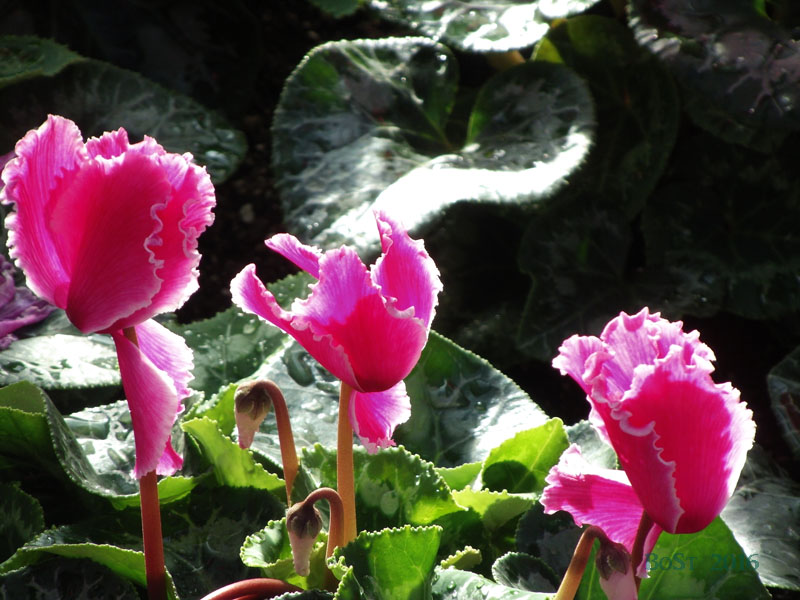
Cyclamen - the Love Flower


Officially we are still in winter. At glance outside one is greeted with gales and snowflakes dancing in the air. It is a beautiful time in which pristine white color blankets the ground, trees, shrubs, hiding all imperfections. It is picturesque beauty despite the cold shiver that forces one to turn away from the window and withdraw back to that cosy seat by the fireplace. Indeed, most houses still have actual working fireplaces, but more and more in densely populated cities, where many dwell in tall high-rises piercing the sky, the choice fireplaces are often electronic simulations. These images of fire with its flames licking the air still cast a romantic atmosphere that warms the heart. 


Speaking of romance, Valentine’s Day is fast approaching and those of you wanting something other than the ordinary should perhaps consider the Cyclamen flower to present to your beloved.
Move over Roses for the Cyclamen flower is also considered the flower of deep love and affection perhaps because the leaves are heart-shaped. In the language of flowers, giving someone cyclamen expresses true love and sincere tenderness for that person.
Love comes in many forms; there is love of parents, children, friends and so forth. So this can be an innocent presentation to express love for one’s children or to a friend, without the connotation of amorous intent, here cyclamen affirms sincerity and lasting feelings.
Likewise, Cyclamen could be given as a representation of maternal love. This is symbolized by the stems from its flower which bend elegantly and with reverence leading the fruit towards the ground.
And if you are superstitious, here is some folklore for your amusement:
One time it was believed that if a woman walked over cyclamen while pregnant she would abort. It is a very powerful purgative. Meanwhile, those who ate cakes made with cyclamen pieces would fall violently in love. Consequently, Cyclamen was often used in spells and in potions for love. Eating the raw root can cause violent purging, but this effect disappears after it is roasted. It can then be pounded into a sort of flour for use in cooking and baking. Small cakes made of the roasted tuber are said to cause the one who eats them to fall violently in love with the one who bakes them, or become violently ill, therefore if you are of a mind to do so, caution is warranted. Nevertheless, it is used sometimes as an addition to wedding cakes.
One time it was believed that if a woman walked over cyclamen while pregnant she would abort. It is a very powerful purgative. Meanwhile, those who ate cakes made with cyclamen pieces would fall violently in love. Consequently, Cyclamen was often used in spells and in potions for love. Eating the raw root can cause violent purging, but this effect disappears after it is roasted. It can then be pounded into a sort of flour for use in cooking and baking. Small cakes made of the roasted tuber are said to cause the one who eats them to fall violently in love with the one who bakes them, or become violently ill, therefore if you are of a mind to do so, caution is warranted. Nevertheless, it is used sometimes as an addition to wedding cakes.
It is certainly a suitable houseplant for adorning the bedroom as it is supposed to increase the libido and fertility. It is also supposed to keep away nightmares and prevent negative spells cast at household members from taking effect. The oil or the flower itself may be worn to protect one against a broken heart. It is also useful for candle-magic love spells. Its best use, either the oil, the plant itself or the powdered, roasted root, is in spells designed to build confidence and self-esteem.
In homeopathic medicine Cyclamen is used to bring on late menstruation and for treatment of vertigo, dizziness and various other ailments involving the head.
Be warned, Cyclamen is considered to be poisonous to cats and fish. Pregnant women should never use this plant, internally or externally, for any purpose!
Here’s a Greek Myth about Hyacynth (which is another name for Cyclamen)
Hyacinth was a beautiful boy and lover of the god Apollo. His problem was that he was also loved by the wind sprite Zephyr. Apollo and Hyacinth once played game of discus throw. Hyacinth ran to catch the disc in order to impress Apollo but Zephyr blew Apollo’s discus off course so Hyacinth was struck by the discus and died. When Hyacinth died, Apollo didn’t allow Hades to claim the boy; he made a flower, the hyacinth, from his spilled blood. According to Ovid’s account, the tears of Apollo stained the newly formed flower’s petals with the sign of his grief.
And finally here are some interesting facts about Cyclamen:
- Cyclamen, with the columbine, was one of the flowers of choice for Leonardo Da Vinci at the beginning of the 16th century, and he often covered the margins of his manuscripts with it.
- Cyclamen, with the columbine, was one of the flowers of choice for Leonardo Da Vinci at the beginning of the 16th century, and he often covered the margins of his manuscripts with it.
-The 17th century Flemish painters scattered cyclamen on the meadows where Jesus had just picked some flowers under the watchful eye of the angels.
-Jean-Jacques Rousseau spoke in his Promenades of the wild cyclamens he discovered in the Alps.
-Louis XIV received them in bunches, along with many other flowers, to decorate the lounges of Versailles.
-After a period of obscurity in the 18th century, the cyclamen made a comeback in fashion, when gardeners in the 19th century cultivated it in Grenelle, near Paris. Its popularity as a symbol of western modernity was exported as far as Japan.
Here are some scientific facts about Cyclamen: They are a perennial plant native to the Mediterranean region and Northeast Africa.
The leaves are green, heart-shaped and variegated and generally appear in late winter.
Flowers appear in autumn on 4-6 inch stalks above the leaves. The flowers are fairy-like consisting of five united petals in white, red, purple with pink being the most common.
They wither during the hottest part of the summer. They are followed by a five-chambered fruit containing sticky seeds.
Happy Valentine’s Day Everyone.
Fin.