Showing posts with label Niagara Falls. Show all posts

Monday, 26 June 2017

The Way of Water

The Way of Water


Highest good is like water.

Because water excels in benefiting the myriad creatures without contending with them and settles where none would like to be, it comes close to the way.


The weak and the supple overcome the hard and the strong.

To yield is to be preserved whole.


To be bent is to become straight.

To be empty is to be full . . .

To have little is to possess.

The stiff and the hard are companions of death,

The supple and the weak are companions of life.

There is nothing softer and weaker than water,

And yet there is nothing better for attacking hard and strong things.


The whole world recognizes the beautiful as the beautiful, yet this is only the ugly;

The whole world recognizes the good as the good, yet this is only the bad.

Thus something and nothing produce each other;

The difficult and the easy complement each other;

The long and the short off-set each other;

The high and the low incline towards each other;

Note and sound harmonize with each other;

Before and after follow each other


In a home it is the site that matters; 


In quality of mind it is depth that matters;

In an ally it is benevolence that matters;

In speech it is good faith that matters;

In government it is order that matters;

In affairs it is ability that matters;

In action it is timeliness that matters.

It is because it does not contend that it is never at fault.


Of old he who was well versed in the way

Was minutely subtle,

Mysteriously comprehending,

And too profound to be known. 


It is because he could not be known

That he can only be given a makeshift description:

Tentative, as if fording a river in winter,

Hesitant, as if in fear of his neighbors;

Formal like a guest;

Falling apart like the thawing ice;

Thick like the uncarved block;

Vacant like a valley;

Murky like muddy water.


Who can be muddy and yet, settling, slowly become limpid?

Who can be at rest and yet, stirring, slowly come to life?

He who holds fast to this way desires not to be full.

It is because he is not full that he can be worn and yet newly made.


If people do not revere the Law of Nature,

It will inexorably and adversely affect them.

If they accept it with knowledge and reverence,

It will accommodate them with balance and harmony


Attain complete emptiness,

Maintain steadfast quietude.

All things flourish

But each one returns to its root.

This return to its root means tranquility.


To hold and fill to overflowing,

Is not as good as it is to stop in time.

Sharpen a sword-edge to its very sharpest,

And the edge will not last long.

Withdraw as soon as your work is done.

Such is Heaven's Way.


(Lao Tzu)


Fin

Sunday, 8 July 2012

Taming the Mighty Dragon


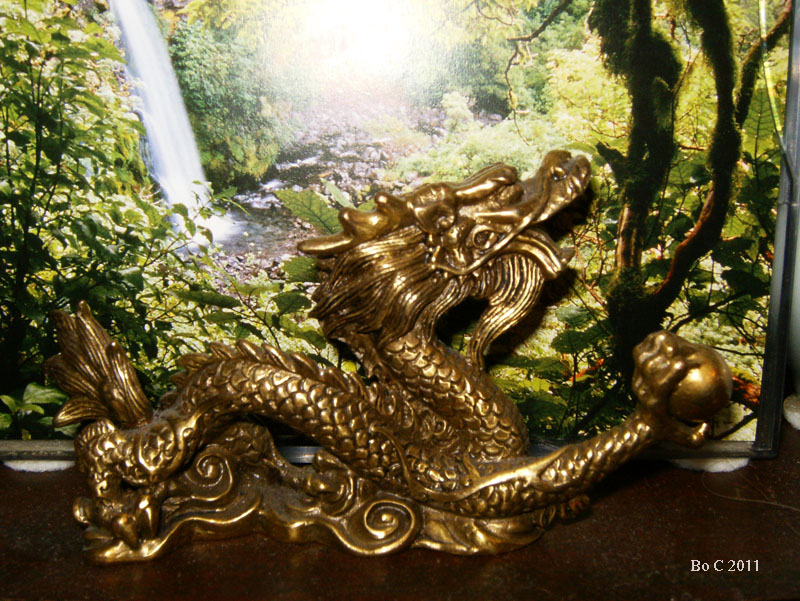
Many cultures viewed the Dragon as a benevolent being, especially in the East where they held the belief that mighty Dragons once ruled the rivers, lakes, seas and skies. Dragons were well respected and even worshipped, especially in the agrarian settlements, for the welfare of men depended on the kindness of these supreme entities. The quantity of folklore that was spanned from their rich imagination has delighted generations of adults and children.
In ancient times it was the province of the immortals to intercede on behalf of humanity with the raw power of nature symbolized by the Water Dragon.

A folk tale: Dragon Taming Lohan
Once upon a time in ancient India the people of a small kingdom, being incited by a demon, went on a rampage against the Buddhists and their monasteries. In the mayhem of destruction, some even stooped to steal the Buddhist sutras.
The Dragon King of the undersea, outraged by the unruly behaviour of these humans, punished them all, the innocent as well as the guilty, by flooding their entire kingdom. As he deemed them most unworthy of benefiting from the wisdom within the holy writings, he took custody of the sutras and stored them in his palace.
In time the repentant people, having suffered so long, wanted the sutras back but nothing would sway the Dragon King’s resolve.  It took an extraordinary being, Nantimitolo, to subdue the dragon guard and restore the sutras back to earth. Hence he is became a Buddhist immortal: the Dragon Taming Lohan.
(Here’s an interesting fact: In China at the end of the ninth century the Buddhist faith had suffered greatly, being subjugated to great persecution under the reign of Emperor Tang Wuzhong who preferred Taosm. A cult was born, out of this staunch resistance which incorporated the Lohan as the powerful guardians of the Buddhist faith.  The last two additions, the Taming Dragon and Taming Tiger Lohan were, in fact, thinly disguised swipes against the thriving Taoism of the time.   
The Taming Dragon Lohan’s Sanskrit name is Nantimitolo. Nanti stands for happy and mitolo, a friend. Together the name means happy friend.  He is called the Taming Dragon Lohan for his brave act of vanquishing the ferocious dragon.  There is a charming verse describes him thus:
“In the hands are the spiritual pearl and the holy bowl,
Endowed with power that knows no bounds,
Full of valour, vigour and awe-inspiring dignity,
He succeeds in vanquishing the ferocious dragon.”)

In modern times we are still entertained by accounts of Dragons through varied visual and literary means but we have also learned to harness falling water, the most powerful of the dwelling places of Dragons, to benefit mankind in yet another way: for what would man do today without the use of electricity?
These pictures tell the story of one such mighty waterfall, its might and how it has been tamed to benefit men:


The End