Showing posts with label folk tale. Show all posts

Friday, 2 May 2014

The Two Jeebi

THE TWO JEEBI


From: The Indian Fairy Book , The Original Legends

Author: Cornelius Mathews


There lived a hunter in the North, who had a wife and one child. His lodge stood far off in the forest, several days' journey from any other. He spent his days in hunting, and his evenings in relating to his wife the incidents that had befallen him. As game was very abundant, he found no difficulty in killing as much as they wanted. Just in all his acts, he lived a peaceful and happy life.

One evening during the winter season, it chanced that he remained out longer than usual, and his wife began to fear that some accident had befallen him. It was already dark. She listened attentively, and at last heard the sound of approaching footsteps.


Not doubting that it was her husband, she went to the door and beheld two strange females. She bade them enter, and invited them to remain. She observed that they were total strangers in the country. There was something so peculiar in their looks, air and manner, that she was disturbed by their presence. They would not come near to the fire. They sat in a remote part of the lodge, shy and taciturn, and drew their garments about them in such a manner as nearly to hide their faces. So far as she could judge, they were pale, hollow-eyed, and long-visage, very thin and emaciated.

There was but little light in the lodge, as the fire was low, and its fitful flashes, by disclosing their white faces and then dropping them in sudden darkness, served rather to increase than to dispel her fears.


"Merciful Spirit!" cried a voice from the opposite part of the lodge; "there are two corpses clothed with garments!"

The hunter's wife turned around, but seeing nobody save her little child, staring across from under his blanket, she said to herself, "The boy cannot speak; the sounds were but the gusts of wind." She trembled, and was ready to sink to the earth.


Her husband at this moment entered, and in some measure relieved her alarm. He threw down the carcass of a large fat deer.

"Behold what a fine and fat animal!" cried the mysterious females; and they immediately ran and pulled off pieces of the whitest fat, which they greedily devoured.

The hunter and his wife looked on with astonishment, but remained silent. They supposed that their guests might have been stricken with famine.


The next day, however, the same unusual conduct was repeated. The strange females again tore off the fat and devoured it with eagerness. The third day, the hunter thought that he would anticipate their wants by tying up a share of the hunt, and placing it apart for their express use. They accepted it, but still appeared dissatisfied, and went to the wife's portion and tore off more.


The hunter and his wife were surprised at such rude and unaccountable conduct, but they remained silent, for they respected their guests, and had observed that they had been attended with marked good luck during the sojourn of these mysterious visitors in their lodge.

In other respects, the deportment of the females was strictly unexceptionable. They were modest, distant, and silent. They never uttered a word during the day. At night they would occupy themselves in procuring wood, which they carried to the lodge, and then, restoring the implements exactly where they had found them, resume their places without speaking. They were never known to stay out until daylight. They never laughed or jested.


The winter was nearly passed away, when, one evening, the hunter was abroad later than usual. The moment he came in and laid down his day's hunt, as was his custom, before his wife, the two females seized upon the deer and began to tear off the fat in so unceremonious a way that her anger was excited. She constrained herself, however, in a good degree, but she could not conceal her feelings, though she said but little.


The strange guests observed the state of her mind, and they became uneasy, and withdrew further still into the remote gloom of the lodge. The good hunter saw the eclipse that was darkening the quiet of his lodge, and carefully inquired of its cause; but his wife denied having used any words of complaining or reproach.


They retired to their couches, and the hunter tried to compose himself to sleep, but could not, for the sighs and sobs of the two females were incessant. He arose on his couch and addressed them as follows:

"Tell me," said he, "what is it that gives you pain of mind and causes you to bemoan your presence here. Has my wife given you offense, or trespassed upon the rights of hospitality?"


They replied in the negative. "We have been treated by you with kindness and affection. It is not for any slight we have received that we weep. Our mission is not to you only. We come from the other land to test mankind, and to try the sincerity of the living. Often we have heard the bereaved by death say that if the lost could be restored, they would devote their lives to make them happy. We have been moved by the bitter lamentations which have reached the place of the departed, and have come to make proof of the sincerity of those who have lost friends. We are your two dead sisters. Three moons were allotted us by the Master of Life to make the trial. More than half the time had been successfully passed, when the angry feelings of your wife indicated the irksomeness you felt at our presence, and has made us resolve on our departure."


They continued to talk to the hunter and his wife, gave them instructions as to a future life, and pronounced a blessing upon them.

"There is one point," they added, "of which we wish to speak. You have thought our conduct very strange and rude in possessing ourselves of the choicest parts of your hunt. That was the point of trial selected to put you to. It is the wife's peculiar privilege. You love your wife. For another to usurp what belongs to her, we know to be the severest test of her goodness of heart, and consequently of your temper and feelings. We knew your manners and customs, but we came to prove you, not by complying with but by violating them. Pardon us. We are the agents of him who sent us. Peace to your dwelling. Farewell!"


When they ceased, total darkness filled the lodge. No object could be seen. The inmates heard the lodge-door open and shut, but they never saw more of the Two Spirits.


The hunter found the success which they had promised. He became celebrated in the chase, and never wanted for anything. He had many children, all of whom grew up to manhood; and he who had lain in the lodge, a little child, while the Jeebi dwelt there, led them in all good deeds, and health, peace, and long life were the rewards of the hunter's hospitality.


The End.


Thursday, 26 July 2012

The Sacred Tree


“The useful declines to be used,
whereas the useless asks to be used.”   Tao.


Once upon a time a well known carpenter named Shih, accompanied by his young and impressionable apprentice, was travelling through the untamed countryside, often taking shortcuts in order to reach the state of Ch’i on time.


Their travels at one point led them to the Shady Circle, where they observed a sacred Li tree in the temple dedicated to the God of Earth.  The tree was immensely huge, so large in fact that it provided shelter to a herd of several thousand cattle and still left room for more. It was a hundred spans in girth, towering up eighty or ninety feet over the hilltop, before it branched out. Countless admiring crowds with their faces turned up, stood there gazing in awe at this miracle on earth.


The apprentice too had halted briefly and fixed his eyes also on this magnificence, thinking how a dozen boats could be cut out of it. He hastened his steps to catch up to his master, who’d continued on his way quite unconcerned. Bit puzzled, he addressed his master tentatively, “Master, in all this time that I’ve been fortunate enough to have handled an adz in your service, I have never seen such superb example of timber. How was it that you, Master, cared not pause a step, to even perfunctorily observe it?”
“Forget about it, it’s hardly worth the mention,” the master shrugged smugly. Observing the puzzled look on the stubborn apprentice’s face however, he relented. “The tree is good for nothing. Made into a boat, it would sink; into a coffin, it would rot; into furniture, it would break easily; into a door, it would sweat; into a pillar, it would be worm-eaten. Despite its size the wood is of no quality, and therefore of no use. That’s why it has survived to attain its present age.”


By dusk of the fifth day, the carpenter and his apprentice had finally reached home. After unburdening themselves of their baggage and washing up, they partook of a satisfying repast. That evening, as he snuggled cozily under the quilts, the carpenter had an unsettling dream.


 He dreamt that the displeased spirit of the tree appeared to him and spoke to him harshly, as follows:
“Your arrogance is unconscionable. What is it tell me you intend to compare me with? Is it with fine-grained wood? Consider the pear, the orange, the pomelo, cherry-apple and all other fruit bearers: as soon as their fruit ripens they are stripped and treated with such indignity. The great boughs are snapped off, the small ones scattered abroad. Thus do these trees by their own value cause injury to their own lives. Sadly they cannot fulfill their allotted span of years, but expire prematurely; all because they are destroyed for bringing forth the admiration of the world."


“Thus it is with all things. In view of this, I’ve strove long and hard to appear useless. Even so, many a time I had a close brush with the peril of being cut down. My wits and my ways however in the end succeeded in deterring them from their aim, and so I endured and grew to these heights; being only useful to myself."


“My kindness now propels me to impart on you few facts:
“In your pitifully brief human history Tsech’i of Nan-po was once travelling on the hill of Shang when he chanced upon a huge tree that greatly astonished him. In his mind he accounted that a thousand chariot teams of four horses could seek shelter under its shade. Reining on his horse under it and pointing he therefore shouted: “What sort of tree is this? Surely it must bear an unusual fine timber.” Then as he looked more closely, he saw that its branches were too crooked for rafters; and looking down he noted that the trunk’s twisting loose grain made it valueless for coffins. Reaching he plucked a leaf and tasted it; at once his face crinkled for it took the skin off his lips. The odor meanwhile was too strong that it would make a man insensate for several days. “Ah!” said Tsech’i, “this tree is really good for nothing, and that is how it has attained this size. A spiritual man might well follow its example of useless.”


“You may also recall that in the State of Sung there is a land belonging to the Ching, where thrive the catalpa, the cedar, and the mulberry. Such as are of one span or so in girth are cut down for monkey cages. Those of two or three spans are harvested for the beams of fine houses. Those of seven or eight spans are cut down for the jointless sides of rich men’s coffins. Alas, they do not fulfill their allotted span of years, but perish under the ax, all too young. Such is the misfortunes that overtake the worthy."


“In contrast; for sacrifices to the River God neither pigs with high snouts, nor bulls with white foreheads, nor men suffering from piles, can be used. For every soothsayer regards these as inauspicious. To the wise, however, these are regarded extremely auspicious, if only to themselves."


“I’m reminded of an account of a certain hunchback named Su. His jaws touched his navel. His shoulders were higher than his head. His neck bone stuck out towards the ultimate sky. His viscera were turned upside down. His buttocks were where his ribs should have been. Yet he lived rather comfortably. By sifting rice, or tailing, or washing, he earned his keep and achieved enough to support a family of ten.
“When the orders for conscription came, whether for the army or for public works, the hunchback walked about unconcerned among his peers, for his deformity excluded him from all such. Meanwhile, when the donations of grain for the disadvantaged and the disabled were handed out, the hunchback received as much as three measures, and when firewood was allotted, ten faggots. If physical deformity was thus sufficient to preserve his body until the end of his days, how much more should a moral and mental deformity avail!"


“Alas, it’s a sad fact that mountain trees invite their own cutting down, lamp oil invites its own burning up. Lacquer can be used, there the tree is scraped; cinnamon bark can be eaten; therefore the tree is cut down. All men know the utility of useful things; but they do not know the utility of futility.
“As you and I are both created things, I ponder on the soundness of this good-for-nothing fellow: you, who’s in imminent danger of death, passing so demeaning a remark on the supposed good-for-nothing tree.”


The subsequent morning the carpenter Shih awakened with a start, covered with perspiration, and sat up on his bed for a while collecting his thoughts. His mind fastened just then on the well known fact:
That when Confucius was in the Ch'u State, the eccentric Chieh Yu passed his door, saying, "O phoenix! O phoenix! How has thy virtue fallen! Wait not for the coming years, nor hanker back to the past. When the right principles prevail on earth, prophets will fulfill their mission. When the right principles prevail not, they will but preserve themselves. At the present day, they are but trying to keep out of jail! The good fortunes of this world are light as feathers, yet none estimates them at their true value. The misfortunes of this life are weighty as the earth, yet none knows how to keep out of their reach. No more, no more, show off your virtue. Beware, beware, and move cautiously on! O brambles, O brambles, wound not my steps! I pick my way about, hurt not my feet!"


Later on that day when the carpenter Shih, heard his apprentice exclaim, "If the tree aimed at uselessness, how was it that it became a sacred tree?"

"Hush!" he responded gravely. "Keep quiet. I was wrong. It merely took refuge in the temple to escape from the abuse of those who do not appreciate it. Had it not become sacred, how many would have wanted to cut it down! Moreover, the means it adopts for safety are different from that of others, and to criticize it by ordinary standards would be far wide of the mark."


A lesson was well learned!


Sunday, 8 July 2012

Taming the Mighty Dragon


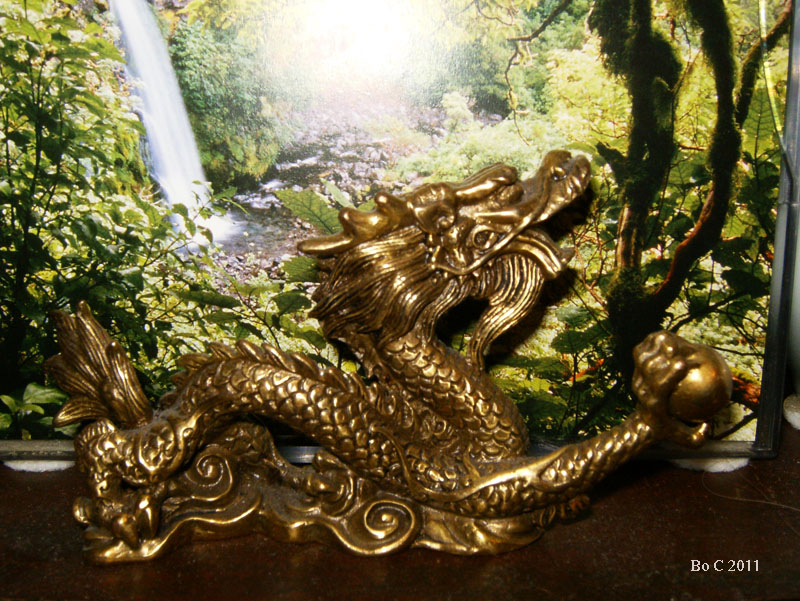
Many cultures viewed the Dragon as a benevolent being, especially in the East where they held the belief that mighty Dragons once ruled the rivers, lakes, seas and skies. Dragons were well respected and even worshipped, especially in the agrarian settlements, for the welfare of men depended on the kindness of these supreme entities. The quantity of folklore that was spanned from their rich imagination has delighted generations of adults and children.
In ancient times it was the province of the immortals to intercede on behalf of humanity with the raw power of nature symbolized by the Water Dragon.

A folk tale: Dragon Taming Lohan
Once upon a time in ancient India the people of a small kingdom, being incited by a demon, went on a rampage against the Buddhists and their monasteries. In the mayhem of destruction, some even stooped to steal the Buddhist sutras.
The Dragon King of the undersea, outraged by the unruly behaviour of these humans, punished them all, the innocent as well as the guilty, by flooding their entire kingdom. As he deemed them most unworthy of benefiting from the wisdom within the holy writings, he took custody of the sutras and stored them in his palace.
In time the repentant people, having suffered so long, wanted the sutras back but nothing would sway the Dragon King’s resolve.  It took an extraordinary being, Nantimitolo, to subdue the dragon guard and restore the sutras back to earth. Hence he is became a Buddhist immortal: the Dragon Taming Lohan.
(Here’s an interesting fact: In China at the end of the ninth century the Buddhist faith had suffered greatly, being subjugated to great persecution under the reign of Emperor Tang Wuzhong who preferred Taosm. A cult was born, out of this staunch resistance which incorporated the Lohan as the powerful guardians of the Buddhist faith.  The last two additions, the Taming Dragon and Taming Tiger Lohan were, in fact, thinly disguised swipes against the thriving Taoism of the time.   
The Taming Dragon Lohan’s Sanskrit name is Nantimitolo. Nanti stands for happy and mitolo, a friend. Together the name means happy friend.  He is called the Taming Dragon Lohan for his brave act of vanquishing the ferocious dragon.  There is a charming verse describes him thus:
“In the hands are the spiritual pearl and the holy bowl,
Endowed with power that knows no bounds,
Full of valour, vigour and awe-inspiring dignity,
He succeeds in vanquishing the ferocious dragon.”)

In modern times we are still entertained by accounts of Dragons through varied visual and literary means but we have also learned to harness falling water, the most powerful of the dwelling places of Dragons, to benefit mankind in yet another way: for what would man do today without the use of electricity?
These pictures tell the story of one such mighty waterfall, its might and how it has been tamed to benefit men:


The End