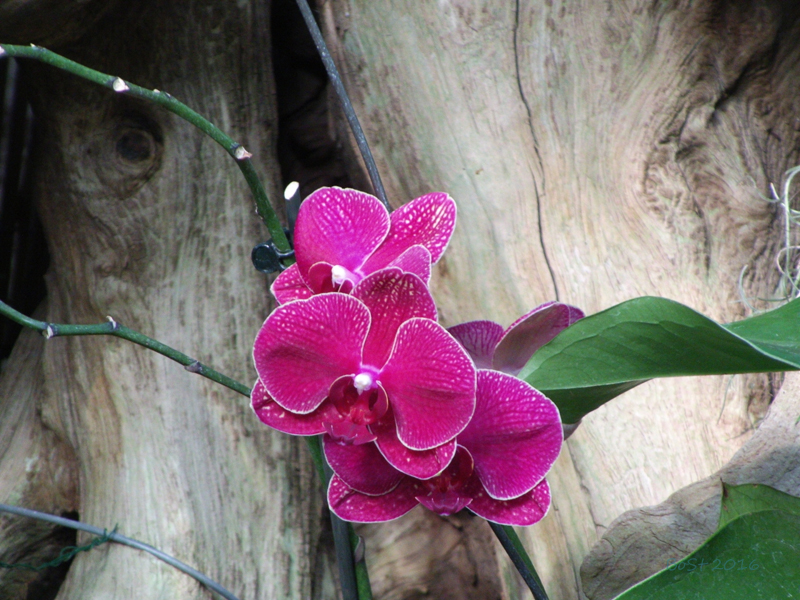
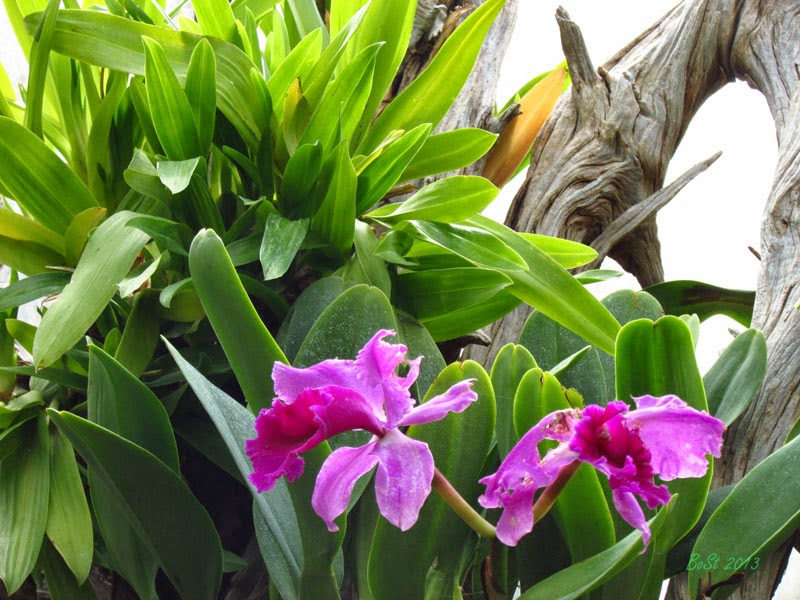
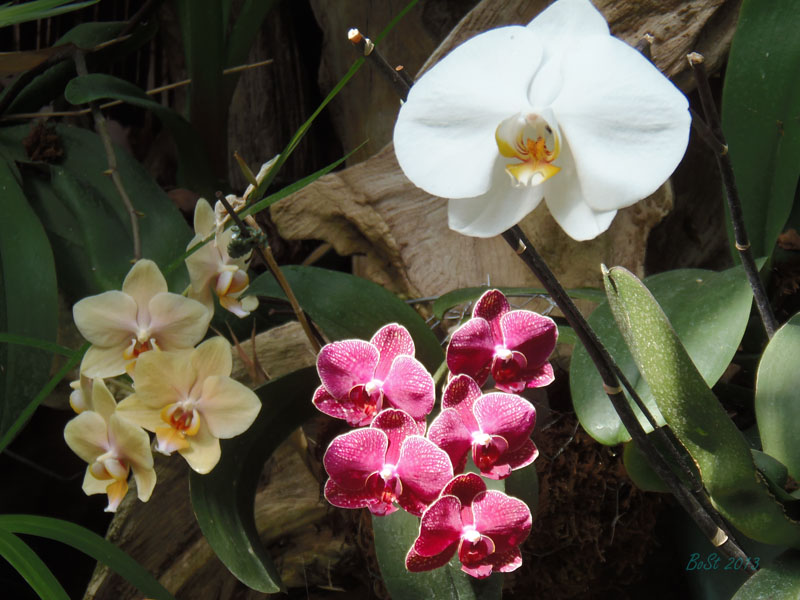
Orchids 2013
The orchid’s name comes from the Greek word literally
meaning "testicle", because of the shape of the root. The Greek myth
of Orchis explains the origin of the plants:
Orchis, the son of a nymph and a satyr, had once come upon a
festival of Dionysus (Bacchus) in the forest. He boldly intruded and began carousing and drinking
till he had far too much. His good sense
gone he became increasingly obnoxious and rowdy and attempted to rape a
priestess of Dionysus. For his grave insult, the infuriated Bacchanalians
bested him and tore him apart. Grieve
stricken Orchis’s father prayed and prayed for him to be restored, but the gods
instead changed him into a flower.
Orchids are interesting flowers by far and somewhat
difficult to nurture. A lot of painstaking care goes into fostering these rare
flowers.
Orchids have bilateral symmetry (zygomorphism), many
resupinate flowers, a nearly always highly modified petal (labellum), fused
stamens and carpels, and extremely small seeds. A majority of orchids are perennial epiphytes,
which grow anchored to trees or shrubs in the tropics and subtropics.
Some orchids, such as
Neottia and Corallorhiza, lack chlorophyll, so are unable to photosynthesize,
ingeniously however they obtain energy and nutrients by parasitising soil fungi
through the formation of orchid mycorrhizas. The fungi involved include those
that form ectomycorrhizas with trees and other woody plants, parasites such as
Armillaria, and saprotrophs. These orchids are known as myco-heterotrophs. They
may continue to obtain carbon from their mycorrhizal fungi during germination
and seedling growth, and even photosynthetic adult plants.
In Europe the Orchid flower in the “language and meaning of
flowers” stands for luxury. To give someone an orchid means: “I will make life sweet for you.”
In China, Orchids, or Lan Hua, are the emblem of love and
beauty, and stands for fragrance and refinement, being also symbolic of
numerous progeny. Confucius remarked on
its exquisite characteristics, and it is therefore emblematic of the perfect of
superior man.
Orchid Pavilion Gathering
 |
(The Orchid Pavilion
Gathering as depicted in an 18th-century Japanese painting)
|
The Orchid Pavilion Gathering (353 CE) was a cultural and
poetic event during the Six Dynasties era, in China. This event itself has a certain inherent and
poetic interest in regards to the development of landscape poetry and the
philosophical ideas of Zhuangzi.
The Orchid Pavilion Gathering of 42 literati included Xie An
and Sun Chuo (320?-380?) and Wang Pin-Chih (fl. 400) at the Orchid Pavilion
(Lanting) near Shaoxing, Zhejiang, during the Spring Purification Festival, on
the third day of the third month, to compose poems and enjoy the wine. As
depicted in this painting: the gentlemen
had engaged in a drinking contest- wine cups can be seen clearly floating down
a small winding creek as the men sit along its banks. Typically whenever a cup stopped, the man
closest to the cup was required to empty it and write a poem. This activity was
known as "floating goblets", or liu shang. In the end, twenty-six of
the participants composed thirty-seven poems.
 |
| Meandering_Stream_at_Lan-ting_Yamamoto_Jakurin_Hanging_scroll_color_on_silk |
 |
Picture of Wang Xizhi
|
The gathering at the Orchid Pavilion is also famous for the
excellent quality of the calligraphy of Wang Xizhi (303-361) who was both
one of the participants as well as the author and calligrapher of the Preface
to the Poems Composed at the Orchid Pavilion.
Tao of Orchid
by
Sungsook Hong Setton
The plum blossom, orchid, chrysanthemum, and bamboo are
considered the four noble (or gentlemen) plants. As one of the four noble plants, the orchid is
often the subject of poems as well as of water-ink paintings. The concept of
the “four noble plants” first appeared in the work of Gin Keyu (1558-1639) and
specifically his record of four plants.
As difficult as it is to paint orchids, it is even more
difficult to paint the orchid’s fragrance.
It is said that Confucius originally drew attention to this
delicate plant, exclaiming: “With a fragrance fit for princes, why are you buried
among the common weeds?”
From olden times the
appearance of the wild orchid, which grew deep in the mountains, was compared
to the mind of a noble and cultivated scholar bureaucrat, who had transcended
the greed and fame-seeking of the secular world. The orchid is known as a symbol
of purity and noble virtue due to its fragrance. This symbolism goes back to
the Ch’in dynasty of the 3rd century. Ch’u Yuan, a patriotic poet, regarded the
orchid as a mirror of one’s moral life.
The rarity and uniqueness of the orchid is vividly expressed
in these two poems which I have translated:
Even though the world is filled with confusion
When I gaze at one orchid
I can forget all my problems.
- Song Sunam
On the dark cliff hundreds of weeds are withering
And yet the orchid bounds with vigor
The noble person dwells in steep, isolated places
He is indeed different from normal people
- Chen Hsie n Chang (Ming dynasty)
The End