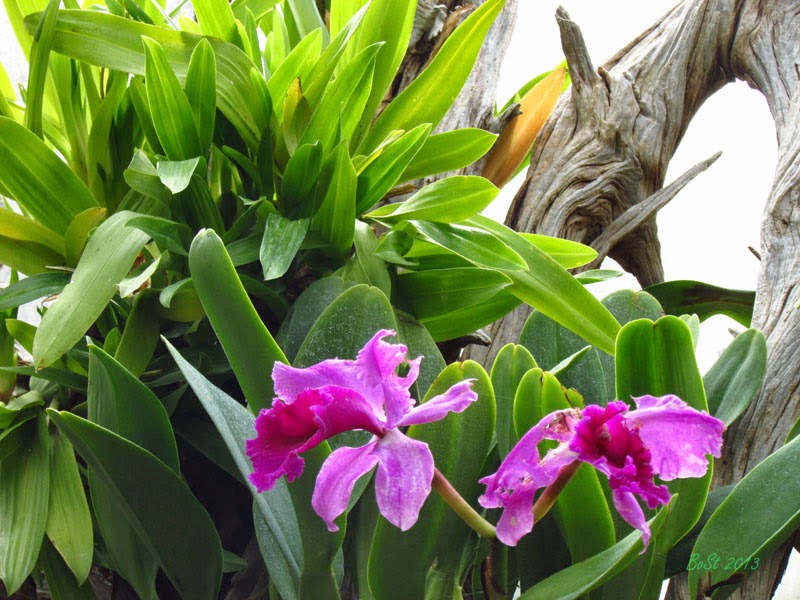
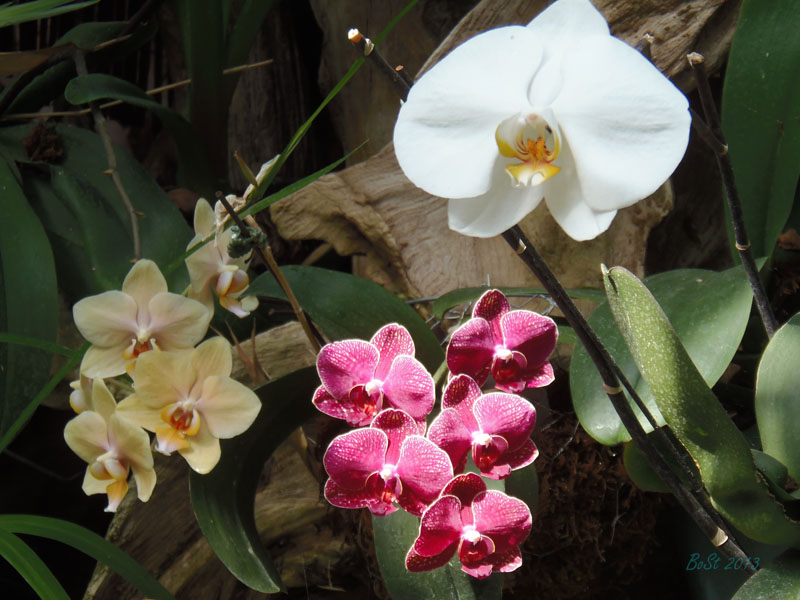
The orchid’s name comes from the Greek word literally
meaning "testicle", because of the shape of the root. The Greek myth
of Orchis explains the origin of the plants:
Orchis, the son of a nymph and a satyr, had once come upon a
festival of Dionysus (Bacchus) in the forest. He boldly intruded and began carousing and drinking
till he had far too much. His good sense
gone he became increasingly obnoxious and rowdy and attempted to rape a
priestess of Dionysus. For his grave insult, the infuriated Bacchanalians
bested him and tore him apart. Grieve
stricken Orchis’s father prayed and prayed for him to be restored, but the gods
instead changed him into a flower.
Orchids are interesting flowers by far and somewhat
difficult to nurture. A lot of painstaking care goes into fostering these rare
flowers.
Orchids have bilateral symmetry (zygomorphism), many
resupinate flowers, a nearly always highly modified petal (labellum), fused
stamens and carpels, and extremely small seeds. A majority of orchids are perennial epiphytes,
which grow anchored to trees or shrubs in the tropics and subtropics.
Some orchids, such as
Neottia and Corallorhiza, lack chlorophyll, so are unable to photosynthesize,
ingeniously however they obtain energy and nutrients by parasitising soil fungi
through the formation of orchid mycorrhizas. The fungi involved include those
that form ectomycorrhizas with trees and other woody plants, parasites such as
Armillaria, and saprotrophs. These orchids are known as myco-heterotrophs. They
may continue to obtain carbon from their mycorrhizal fungi during germination
and seedling growth, and even photosynthetic adult plants.
In Europe the Orchid flower in the “language and meaning of
flowers” stands for luxury. To give someone an orchid means: “I will make life sweet for you.”
In China, Orchids, or Lan Hua, are the emblem of love and
beauty, and stands for fragrance and refinement, being also symbolic of
numerous progeny. Confucius remarked on
its exquisite characteristics, and it is therefore emblematic of the perfect of
superior man.
Orchid Pavilion Gathering
(The Orchid Pavilion
Gathering as depicted in an 18th-century Japanese painting)
The Orchid Pavilion Gathering (353 CE) was a cultural and
poetic event during the Six Dynasties era, in China. This event itself has a certain inherent and
poetic interest in regards to the development of landscape poetry and the
philosophical ideas of Zhuangzi.
The Orchid Pavilion Gathering of 42 literati included Xie An
and Sun Chuo (320?-380?) and Wang Pin-Chih (fl. 400) at the Orchid Pavilion
(Lanting) near Shaoxing, Zhejiang, during the Spring Purification Festival, on
the third day of the third month, to compose poems and enjoy the wine. As
depicted in this painting: the gentlemen
had engaged in a drinking contest- wine cups can be seen clearly floating down
a small winding creek as the men sit along its banks. Typically whenever a cup stopped, the man
closest to the cup was required to empty it and write a poem. This activity was
known as "floating goblets", or liu shang. In the end, twenty-six of
the participants composed thirty-seven poems.
The gathering at the Orchid Pavilion is also famous for the
excellent quality of the calligraphy of Wang Xizhi (303-361) who was both
one of the participants as well as the author and calligrapher of the Preface
to the Poems Composed at the Orchid Pavilion.
Tao of Orchid
by
Sungsook Hong Setton
The plum blossom, orchid, chrysanthemum, and bamboo are
considered the four noble (or gentlemen) plants. As one of the four noble plants, the orchid is
often the subject of poems as well as of water-ink paintings. The concept of
the “four noble plants” first appeared in the work of Gin Keyu (1558-1639) and
specifically his record of four plants.
As difficult as it is to paint orchids, it is even more
difficult to paint the orchid’s fragrance.
It is said that Confucius originally drew attention to this
delicate plant, exclaiming: “With a fragrance fit for princes, why are you buried
among the common weeds?”
From olden times the
appearance of the wild orchid, which grew deep in the mountains, was compared
to the mind of a noble and cultivated scholar bureaucrat, who had transcended
the greed and fame-seeking of the secular world. The orchid is known as a symbol
of purity and noble virtue due to its fragrance. This symbolism goes back to
the Ch’in dynasty of the 3rd century. Ch’u Yuan, a patriotic poet, regarded the
orchid as a mirror of one’s moral life.
The rarity and uniqueness of the orchid is vividly expressed
in these two poems which I have translated:
At the conclusions of the old year after the seconds are
counted down and the stroke of midnight resounds there is always one song: Auld Lang Syne that is loudly sung by people
of all ages, races and creeds to usher in the New Year.
Usually everyone joins hands with the person next to them to
form a great big circle. At the beginning of the last verse, everyone crosses
their arms across their breast, so that the right hand reaches out to the
neighbour on the left and vice versa. When the song ends, everyone rushes to
the centre while still holding hands, shrinking the circle, and then everyone
turns under their arms to end up facing outwards with their hands still joined.
Sounds like loads of fun, right?
Join me by clicking on the Link to sing along the Auld Lang
Syne, as you view seasonal pictures of the last year:
More info about Auld Lang Syne:
Did you know that Auld Lang Syne is actually a Scots poem
written by Robert Burns in 1788? The poem later on was set to the tune of
traditional folk song. From its humble beginnings it was always deemed an
appropriate song for New Year, for it symbolizes “endings and new beginnings”.
It is therefore also sung at graduations, funerals and as a farewell to persons
leaving on a journey. The literal English interpretation of the title “Auld
Lang Syne” can be any one of these: “Old long since” or, more idiomatically, “Long
long ago”, “Days gone by” or “Old times.”
The song begins with a rhetorical question as to whether it is right that
the old times be forgotten, and encourages one to be mindful of long-standing
friendships. In the publication of “Select Songs of Scotland”, by Thomson in
1799, the second verse of “Old Lang Syne” about greeting and toasting, was
moved to its present position at the end.
Robert Burns had sent the copy of the original song to the
Scots Musical Museum with the remark, “The following song, an old song, of the
olden times, and which has never been in print, nor even in manuscript until I
took it down from an old man”. Suffice to say some of the lyrics were indeed
“collected” rather than composed by the poet. The ballad “Old Long Syne”
printed in 1711 by James Watson shows incredible similarity in the first verse
and the chorus to Burn’s later poem, and is almost certainly copied from the
same “old song”. The rest of the poem can be attributed to Burns himself;
however, there is some speculation as to whether the melody widely used in
Scotland and the rest of the world today is the same one Burns had originally used.
One thing is for certain it is a very contagious song. The song sang on
Hogmanay or New Year’s Eve quickly became a Scots custom that soon spread like
wildfire to other parts of the British Isles. As Scots, including English,
Irish and Welsh immigrants, settled around the world they took with them this old
tradition. In America, the Canadian band leader Guy Lombardo in 1929 used it in
his New Year’s Eve celebrations through his annual broadcasts on radio and
television. The song soon became his trademark and the rest, as they say, is
history.
Lyrics:
Auld Lang Syne
Should auld acquaintance be forgot,
And never brought to mind?
Should auld acquaintance be forgot,
And days of auld lang syne?
And days of auld lang syne, my dear,
And days of auld lang syne.
Should auld acquaintance be forgot,
And days of auld lang syne?
We twa hae run aboot the braes
And pu'd the gowans fine.
We've wandered mony a weary foot,
Sin' days of auld lang syne.
Sin' days of auld lang syne, my dear,
Sin' days of auld lang syne,
We've wandered mony a weary foot,
Sin' days of auld ang syne.
We twa hae sported i' the burn,
From morning sun till dine,
But seas between us braid hae roared
Sin' days of auld lang syne.
Sin' days of auld lang syne, my dear,
Sin' days of auld lang syne.
But seas between us braid hae roared
Sin' days of auld lang syne.
And ther's a hand, my trusty friend,
And gie's a hand o' thine;
We'll tak' a cup o' kindness yet,
For auld lang syne.
For auld lang syne, my dear,
For auld lang syne,
We'll tak' a cup o' kindness yet,
For auld lang syne.
(c) 2000 McGuinn Music / Roger McGuinn
Folk Den Songs by Roger McGuinn is licensed
under a Creative Commons Attribution-Noncommercial-No Derivative Works 3.0
United States License.
Happy
New Year Everyone; Wishing you all a healthy, joyous and prosperous 2013.