Saturday, 14 July 2012

BoSt Galleries Exhibit 8


The Gates of Paradise
Once upon a time a mighty warrior Nobushige visited a temple where famed Zen master Hakuin resided. Having been received by him, Nobushige perfunctorily bowed than promptly took up a seat across from the worthy master. As he was not one to mince with words, he cleared his throat and immediately voiced his pressing inquiry: “Tell me master, is there really a paradise and hell?” 
“Who are you?”  Hakuin looking directly at him, inquired.
“I am a samurai,” The warrior bit miffed, loudly ejected.
“You, a samurai?” Hakuin now scoffed. “What kind of a ruler would have you as his guard? Your demeanor resembles more that of a common, street beggar.”
Proud Nobushige was so incensed, scowling he began to unsheathe his sword, but Hakuin shaking his head calmly added, “I see you have a fine sword!  Still,” the master shrugged, “the blade is probably far too dull to sever my head.”
“I’ll show you how dull it is!” infuriated Nobushige at once rose his hand and was about to unleash his renowned deadly strike, when Hakuin, not in the least bit perturbed, loudly remarked: “Here, open the gates of hell!”
The Samurai, at once perceiving the master’s discipline, recoiled and after bowing respectfully to the master contritely sheathed his sword.
“Here open the gates of Paradise.” Hakuin, sporting a warm smile, now said.
Zen Story

Sunday, 8 July 2012

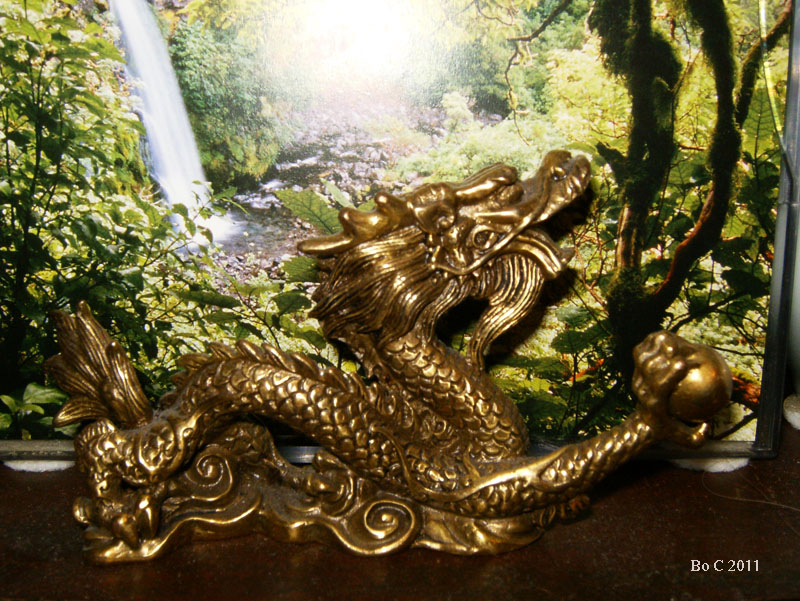
Taming the Mighty Dragon


Many cultures viewed the Dragon as a benevolent being, especially in the East where they held the belief that mighty Dragons once ruled the rivers, lakes, seas and skies. Dragons were well respected and even worshipped, especially in the agrarian settlements, for the welfare of men depended on the kindness of these supreme entities. The quantity of folklore that was spanned from their rich imagination has delighted generations of adults and children.
In ancient times it was the province of the immortals to intercede on behalf of humanity with the raw power of nature symbolized by the Water Dragon.

A folk tale: Dragon Taming Lohan
Once upon a time in ancient India the people of a small kingdom, being incited by a demon, went on a rampage against the Buddhists and their monasteries. In the mayhem of destruction, some even stooped to steal the Buddhist sutras.
The Dragon King of the undersea, outraged by the unruly behaviour of these humans, punished them all, the innocent as well as the guilty, by flooding their entire kingdom. As he deemed them most unworthy of benefiting from the wisdom within the holy writings, he took custody of the sutras and stored them in his palace.
In time the repentant people, having suffered so long, wanted the sutras back but nothing would sway the Dragon King’s resolve.  It took an extraordinary being, Nantimitolo, to subdue the dragon guard and restore the sutras back to earth. Hence he is became a Buddhist immortal: the Dragon Taming Lohan.
(Here’s an interesting fact: In China at the end of the ninth century the Buddhist faith had suffered greatly, being subjugated to great persecution under the reign of Emperor Tang Wuzhong who preferred Taosm. A cult was born, out of this staunch resistance which incorporated the Lohan as the powerful guardians of the Buddhist faith.  The last two additions, the Taming Dragon and Taming Tiger Lohan were, in fact, thinly disguised swipes against the thriving Taoism of the time.   
The Taming Dragon Lohan’s Sanskrit name is Nantimitolo. Nanti stands for happy and mitolo, a friend. Together the name means happy friend.  He is called the Taming Dragon Lohan for his brave act of vanquishing the ferocious dragon.  There is a charming verse describes him thus:
“In the hands are the spiritual pearl and the holy bowl,
Endowed with power that knows no bounds,
Full of valour, vigour and awe-inspiring dignity,
He succeeds in vanquishing the ferocious dragon.”)

In modern times we are still entertained by accounts of Dragons through varied visual and literary means but we have also learned to harness falling water, the most powerful of the dwelling places of Dragons, to benefit mankind in yet another way: for what would man do today without the use of electricity?
These pictures tell the story of one such mighty waterfall, its might and how it has been tamed to benefit men:


The End


Saturday, 30 June 2012

BoSt Galleries Exhibit 7


Transformations

“Everything on earth is subject to change. Prosperity is followed by decline:
this is the eternal law on earth. Evil can indeed be held in check but not
permanently abolished. It always returns. This conviction might induct
melancholy, but it should not; it ought only to keep us from falling into
illusion when good fortune comes to us. If we continue mindful of the
danger, we remain persevering and make no mistakes. As long as a man's
inner nature remains stronger and richer than anything offered by external
fortune, as long as he remains inwardly superior to fate, fortune will not
desert him.”

I Ching

Sunday, 24 June 2012

BoSt Galleries Water Lily Watercolours – Exhibit 1


“Strive to quiet the elusive, restless, agitated mind.
Observe your thoughts.
Observe the patterns of your thoughts
And you will see them disappear.
With the mind free of thought you will know peace.”
Buddha

Thursday, 21 June 2012

Bo's Dragon Lore: The Dragon Boat Festival


The History of the Dragon Boat Festival 


In Canada we are a multicultural community and, as a result, we are richer by far in our human experiences. One such experience is the Dragon Boat Festival. I became aware of this some years back and, though I am not of Chinese origin, it has held my interest just the same. The festival may have started in China countless years ago but it is now an annual event celebrated throughout the world with participation from well over 40 countries. 

In Toronto, from the humble beginnings of the first Festival in 1989 with only 27 teams participating until the 24th Annual Dragon Boat Festival, the event has grown tremendously. This year there are teams from all over Canada, from the U.S, the Caribbean Islands, Europe and Asia. It will be held June 23-24, 2012 at Toronto Centre Island. They are anticipating about 180 to 200 teams, including 11 teams of individuals with physical and developmental challenges, to compete with over 5000 athletes. The festival has an added advantage of raising funds for charitable organizations, this year the beneficiary will be the Canadian Diabetes Association.


For those history buffs, here’s an additional succinct account of the Dragon Boat Festival in Canada:


“As early as 1945, the Vancouver Sun newspaper contains a story and picture of a dragon-adorned silver plaque presented to the Mayor of Vancouver by representatives of the republican government of China immediately following cessation of hostilities of World War II in the Pacific. The news story explains that because Vancouver was the North American gateway to Asia, it could be considered as the ideal city to host the first dragon boat race outside of Asia. The proposed post war dragon boat festival was compared to the Mardi Gras of New Orleans. Since 1946 was to be the Diamond Jubilee (60th Anniversary) of the city, it was suggested that a dragon boat festival be convened to mark this occasion. However, this would have to wait until the city's 100th anniversary in 1986 and the world transportation exposition. 
In 1992, the (final) British Governor of Hong Kong, Christopher Patton, presented a teak dragon boat to the Canadian Prime Minister of the day, Brian Mulroney, to mark the close cultural, social and business ties between Hong Kong and Canada. This craft is now part of the permanent collection of the Canadian Museum of Civilization in Gatineau, Quebec. Canada reciprocated by presenting a carved cedar totem pole crafted by British Columbia First Nations members. This symbol of friendship is displayed in a park in Hong Kong.” 
Several of the larger dragon boat events outside of Asia include Vancouver’s Canadian International Dragon Boat Festival in Vancouver, British Columbia, the Toronto International Dragon Boat Race Festival in Toronto, Ontario, and the Ottawa Dragon Boat Festival in Ottawa, Ontario. These three Canadian festivals each feature some 200 crew and are all held on a weekend close to the June Summer Solstice, in keeping with traditional Chinese dragon boat traditions.” 

In case you are unfamiliar of the origin of this 2000 year old event, here’s a brief summary: 

The pre-imperial Warring States period (475-221 BC) is considered a classical age in Chinese history, during which Confucius, Lao Tse and Sun Tzu lived and the classic military strategy “The Art of War” was written.  In this period, in the southern state of Chu (present day Hunan and Hubei provinces), there lived a most notable statesman Qu Yuan (Chu Yuan).  
The great poet Ch’u Yuan became a minister for King Huai of Ch’u as a young man. He was saddened by how the people had suffered from ceaseless war
He is still considered a champion of political loyalty and integrity, as he tirelessly tried to maintain the Chu state's autonomy and hegemony.
The alliance posed an effective deterrent to Ch’in’s ambition. It also earned Minister Ch’u more prestige giving him the right to oversee a wide spectrum of domestic and diplomatic affairs.


Because he was a most upstanding individual he became victim to the malicious slanders of other corrupt ministers and jealous bureaucrats’ who had the ear of the Emperor and had him banished.


 A group of Ch’u aristocrats led by Prince Tzu-lan became jealous of Ch’u. They often complained to King Huai of Ch’u's alleged arrogance and waywardness. Hearing more and more complaints,the king became less satisfied with his minister  


 While in exile however, he continued to write some of the greatest literature and poems, expressing his ardent loyalty and love for his state and divulging his deep concern for its precarious future. 


The poem was read by people in the Ch’u court, and was used by Tzu-lan and Chin Shang against Ch’u. They told King Huai that in the poem he was compared with a despotic ruler. The king was enraged and dismissed Ch’u Yuan from his official post


Then one day, in the year 278 B.C. upon learning of the imminent invasion by a neighbouring State (Qin), he did his best to warn his Emperor and countryman.


Chang explained that, among the six states, Ch’i and Ch’u were the strongest. Once discord was sown between these two, the anti-Ch’in alliance would fall apart. He offered to make a trip to see if he could take the advantage of Ch’u's internal confilict to undermine the alliance.
He still believed the king would see the truth, but he was no longer summoned. He was so depressed that he couldn’t sleep at night. 
Ch’u Yuan despaired. He rushed back to Yingtu to help reorganize the resistance against Ch’in.
The alliance with Ch’i failed soon after, and beginning with the 27th year of King Huai’s reign, Ch’u was repeatedly invaded by Ch’in.
Ch’u was upset. 


Having failed in his communication however, as a form of protest against the corruption of the era, he strode into the Miluo River holding a rock, committing a ritual suicide.


He walked along the river, cursing the enemy and the greed of politicians. He was determined to arouse his people’s patriotism and condemn those who had destroyed Ch’u State by taking his own life.
He took off his clothes, tied a rock to his waist, and plunged into the river. That day was the fifth day of the Chinese lunar calendar
This was his last resort to awaken Chu to the impending danger.

The ordinary folks upon learning of Qu’s heroic act, rushed out on the water in their fishing boats to try desperately to find him in time to save him. In desperate attempt, they beat the drums and splashed the water with their paddles to keep the evil spirits and fish away from claiming the poet’s submerged body. They sprinkled rice dumplings in to the river to feed the fish to deter them from gorging on Qu’s flesh. Then late one night the spirit of the poet appeared before his closest friends and told them that the rice offering was being intercepted by an enormous river dragon. He asked that they wrap their rice into three-cornered silk packages to ward off the dragon. These “zongzi” or sticky rice wrapped in leaves (instead of silk) has been the official commemorative food ever since. 


Believing that the patriotic poet would enjoy eternal life, they would row dragon boats out on the river to look for him. Ch’u Yuan became a symbol of patriotism for the Chinese people.
Indeed, from that time on at the anniversary of Qu Yuan’s death, the fifth day of the fifth month in the lunar calendar, the ordinary citizens in commemoration of his memory have enacted this folk ritual, by means of Dragon Boat Races. The modern times this has evolved into an international sport event held in Hong Kong since 1976. The boats used today are traditionally made of teak wood. These very long, narrow, canoe-style vessels are usually adorned with carved ornamental heads and tails of dragons. The decorative regalia is absent during training but the drum is always present. Dragons are represented here because of the belief that they are the rulers of rivers and seas and dominate the clouds and rains of heaven. 

Another interesting Fact about the name: Dragon boat races were traditionally held as part of the annual Duanwu Festival or Duen Ng observance in China. Duen Ng falls on the fifth day of the fifth month, also referred to as “double fifth”. It’s determined to be so because of the combination of solar and lunar cycles which are different from Gregorian calendar, where it is placed during the month of June. During 19th century European observers of the racing ritual, not understanding the significance of Duen Ng, referred to the spectacle as a “dragon boat festival”. This is the term that has become known in the West.

(Note: The Emperor Qin Shi Huang of Qin (or Chin) kingdom did eventually conquer all of the other states including Chu and unified them into the first Chinese empire.)