Showing posts with label evil spirits. Show all posts

Tuesday, 3 February 2026

DRAGON LONGZE FALLS IN LOVE (BOST ORIGINAL STORY, 2026 PART 2)

 DRAGON LONGZE FALLS IN LOVE (BOST ORIGINAL STORY, 2026 PART 2)


Then came a time of the Mid Autumn Festival. The particulars of the annual festival, through natter (gossip, blather), without fail reached far and wide, even the remotest regions, drawing significant crowds to the event at Hurin.


01- MID AUTUMN FESTIVAL (2)jp

The festival had always delighted the senses with the array of colourful decorations, exquisitely crafted lanterns and kites. Multitude booths displayed hand crafted toys, jewelry and keepsakes; delicious and aromatic abundant food stalls, meanwhile, satisfied every penchant palate (food, appetite). The delightful melodies, tunes emanating from diverse instruments, perforated the air, accompanying the varied entertainment of street operas, graceful dances, or enthralling acrobatics- that were enjoyed by the enthusiastic crowds of human families and loving couples.  

The eligible handsome young men, in the meantime, ceased this opportunity to spot potential mates, while others gaged (evaluated, assessed) or flirted with beautiful, coy (bashful) ladies, dressed in in their fineries. In this jocund (blithe, amiable) atmosphere one and all, young and old, milled about with rare abandon and continuously, with joyful zeal, had week-long, fun-filled memorable experiences.

Where were the criminals, the bad elements, the ruffians during this time, you may wonder. But because of the endorsed (confirmed) rich economic advantages of the festival (for the region), the constables were dispatched on mass for the duration to ensure the safe and uninterrupted mirthful participation (partaking) of all its citizens.

Longze and Brenda despite their qualm (misgivings) about humans, were riveted (enthralled) by all the hearsay about the incessant, boisterous annual event. Wishing to experience it firsthand hence, the two serpents one white and one green, one fine day transformed themselves into two young ladies and, appropriately dressed, embarked on the long journey.


02- LONGZE AND BRENDA (3) JP

They walked for two days on foot, sometimes traversing difficult terrain (land, topography), then secured a passage on a small boat, to finally at dawn of the subsequent day, arrive at the vicinity (locale), the hub, at picturesque Hurin.  

They rested under the shade of a tree for a while, then discreetly blended in with the crowd, to enjoy the festivities. Longze and Brenda’s attires were adequate, but not as rich; bothered by the scathing (scornful, mocking, derisive) looks from passers by, Longze accosted one friendly merchant and got the directions to a respectable clothing shop.  

When they had first entered the establishment, they were greeted cooly by the proprietor, who quoted the price for two ready made dresses that were available in their sizes, expecting them to bashfully withdraw. But instead, when Longze boldly produced three gold coins, which were considerably far more than the asking price, the proprietor became all smiles. Fawning on them henceforth, two of his female staff (employees) ushered the two young ladies Longze and Brenda to the back room, they then promptly retrieved from the racks few already completed exquisite gowns. 

Subsequently, with all their needs solicitously met, Longze and Brenda emerged from the shop, confident and looking radiantly beautiful. They once more blended in with the crowds, this time however, receiving admiring looks from every young man, while envy registered in the pupils of the female counterparts.

Later that morning, Longze and Brenda without abandon talked and laughed as they breakfasted on sesame steam buns, pancakes with honey and jam and chicken hot noodles. Strolling through the food stalls, they later indulged their palate (appetite) for sweets and sampled other, strange but delectable morsels.  At noon, they drunk refreshing drinks, purchased trinkets and keepsakes and for a while watched some of the entertainment. In short, they took in the general sites, as they frequently dodged the unwarranted attention from several young men.


03-LONGZE AND BRENDA IN GOWN (31)JP

The eastern part of Lake Taho lied beside the prosperous (trading port) city of Monter and bordered by lush green hills; it had always been renowned for its breathtaking scenery drawing many scholars or noted visitors who loved to stroll its banks or take boats across the water.

Longze and Brenda, were so enthralled by the beauty of the surroundings that they’d without intending to, strayed quite far from the crowds, desiring to observe the magnificent waterfalls up close. There, throwing all caution into the wind, they’d lingered for a time quite forgetting themselves; however, as luck would have it, at the far bend (curvature, stoop), at a secluded spot that had an ancient, somewhat dilapidated (derelict, rundown) terrace, a dashing young scholar named Jedrik Nenzo, stood leaning over the ivy assailed (overrun) ramshackle (rickety) railing. He was also admiring the sights from that lone ventage point, when he just then happened to spot Longze. This serious young scholar, for a time stood mesmerized, discreetly observing this enchanting young lady.


04-JEDRIK NENZO (14)JP

As it were, the scholar was simply returning from a visit to his mother’s grave.  He had been orphaned when young and presently lived with his elder sister and her husband, earning a scant living as an assistant in their herbal medicine shop. Jedrik was a breathtakingly handsome (striking) young man of about twenty-five years of age, his height was well over six feet tall, with long white, blond hair cascading down his shoulders and brilliant blue eyes. His nature, however, was taciturn (reserved, aloof, introverted, shy) and so he’d often shunned crowds and instead, buried his head in books.

Providence (fate) had decreed however that Longze and Jedrik should meet that day; as they later crossed the Azura Bridge, each (in midst, melded) blended in a mob of people, headed in the opposite direction, Longze (from the corner of her eye) glimpsing at him, his striking good looks simply (stilled) stole her breath away.

Having crossed the bridge, when suddenly the capricious sun took refuge behind some clouds and abruptly rain begun to fall, the two ladies naturally sought shelter under the nearby willow tree, but without much success. 

Jedrik, a gallant young man, even though he’d quietly with lowered head bypassed them, his intuition making him look back, noted the two young ladies at the opposite end of the bridge, presently in dire straits; uncharacteristically, he’d not hesitated and, hastened over at once to politely offer them his umbrella.


05-JEDRIK NENZO (28)JP

As Longze insisted on Jedrik sharing the umbrella with them the two, during their brief conversation, had hopelessly fallen in love.  Destiny had played a hand, you see, to draw these two lovers together.

To make the long story short, Longze (or Berdis Kenny as she’d introduced herself to the scholar), throwing all caution to the wind, three days hence, married the scholar, Jedrik Nenzo. The happy couple (taking along Brenda to live with them) then moved to the suburb of Monter and there, with the sizeable funds from Longze’s supposed inheritance, opened a medicine shop of their own. Utilizing her extensive knowledge of various herbal medicines, they were able to successfully cure many ailments, and before long the business prospered. Berdis (Longze) especially was much beloved because of her dedication to helping the sick, no matter how poor they were.

Oh, but oh so fickle is fate; for the (terrapin) Muskrat spirit that once dwelled in the same segment of lake Taho as Longze had, by this time, accumulated enough powers to take on a human form and had transformed into a Spiritualist (diviner, seer) called Khronos who, without much success, also dabbled in the healing arts. He learned about the brilliance of Berdis and, to his chagrin, discovered that she is his old nemesis Longze, the white snake.  He was further consumed by jealousy when he found out about her blissful existence and from then on plotted to break up her relationship with Jedrik Nenzo. He visited their shop and, finding an opportunity, discretely approached Jedrik when Berdis, by then an expectant mother, went off for a brief respite leaving her husband to tend to customers.


06-KHRONOS (8)JP

 “I’m Khronos, the famed Psychic ((diviner, seer)),” the disguised Muskrat spirit introduced himself to Jedrik in a conspiratorial whisper. “I have come here, under this pretext, to warn you of the great peril you are in. Through my spiritual guide, I have discovered that your wife is in fact, a 500-year-old (actually, he’d just on spur made up that number) sprite white snake. Heed my words young man, for now she hides well her true nature, but one day she will surely turn on you, as all demons do, and devour you!”

“How dare you say such a thing?” protested Jedrik. “My wife is an angel, what you say is nothing short of a wicked slander!”

“Fine, fine; don’t take my word for it.” Khronos shaking an index finger, sternly admonished Jedrik. He next pretended to storm out the door but, as if on a second thought, he halted and, half turning, said, “Before long the Winter Solstice Festival will be here. Offer her realgar wine, if she does not revert back to her true form, then I, in advance, offer my apologies.”

                                                                                             ~


At the Winter Solstice Festival, according to an old custom, everyone would liberally partake of wine mixed with foul-smelling realgar to supposedly to drive away snakes or evil spirits.

To escape disclosure and wary of the possible dangers, Berdis had feigned illness during this Festival. She insisted on keeping to her bed but encouraged her husband to go out and partake of the festivities, while Brenda (the fairy, Green Snake) kept her company and also, tended to her (pregnant) needs. That might have been the end of that but unfortunately, however, the devoted Jedrik had refused to leave her side and, desiring her to be especially safe, he further insisted that she drink some measure of the realgar concoction. When she adamantly refused and offered only feeble excuses Khronos’s dire warnings rushed to Jedrik’s mind. His demeanor darkened but then just as quickly he dismissed it all with a wave of his hand. When his wife inquired as to the reason for his odd behaviour, Jedrik simply shrugged and related the warning words of Khronos, thinking it to be nothing other than a poor joke.

Berdis (Longze) could not conceal her ire and terror, and her face grew visibly pallid. The wave of suspicion that grazed her husband’s eyes, though briefly, wrenched Berdis’s heart.  Hoping that her accrued powers were strong enough to withstand the danger she dismissed Brenda and requested a cup of realgar wine from her husband.


07-BERDIS AND JEDRIK NENZO (73)JP

Receiving it, she quickly downed it. As further reassurance she pretended to like it and asked for more, but before she could finish the third, she began to retch violently.  She was helped to her bed by her most concerned and apologetic husband who then rushed out the door to fetch her some medicine.  When he returned, he found, instead of his wife, a giant white snake coiled on the bed.


08-WHITE SNAKE (9)JP

Worst still, this white snake had some horns on its head. And scales were beginning to manifest on the white skin. Berdis had had a tranquil life; nothing therefore prepared her for this present transformation.

In truth Berdis, which was the dragon Longze, had now matured enough that he/she, with her ancient lineage (overriding her sentence), she could be transformed into a mighty dragon. The trigger was the realgar wine on top of her pregnancy and the hormones it entailed.  And so, the violent shift soon began to transform Longze into her innate, tremendous white dragon self.  Before she grew too huge to be contained in the room, she spread her wings and bolted out the open window, disappearing into the night’s sky.


09-WHITE DRAGON (4)JP


The shock of this transformation, meanwhile, had been too great for Jedrik to bear and he’d instantly collapsed (unconscious) onto the floor.


10- JEDRIK NENZO (87)JP


                                                                                            ~


(END OF PART 2)

(NEXT POST - THE CONCLUSION PART 3) 


Tuesday, 4 November 2025

THE DRAGONS IN JOURNEY TO THE WEST (REVISED 2025)


THE DRAGONS IN JOURNEY TO THE WEST (REVISED 2025)


The Dragons in Journey to the West is one of the Four Major Classical Novels of Chinese literature written in the 16th century during the Ming Dynasty. Its authorship was attributed to Wu Cheng’en. The novel is a fictionalized account of the legendary pilgrimage to the "Western Regions” by the Buddhist monk Xuanzang to obtain sacred Buddhist texts called sutras.


In real life, Xuanzang (c. 602 – 664) was a monk at Jingtu who actually travelled to India during the Tang Dynast. He left Changan in 629, seeking to attain better transcripts of Buddhist scriptures despite the fact that the borders were closed because of the ongoing war with the Göktürks. Xuanzang’s determination and persistence paid off and helped by sympathetic Buddhists, he travelled via Gansu and Qinghai to Kumul (Hami), then onto Tian Shan Mountains to Turpan. His journey led him across to what are today Kyrgyzstan, Uzbekistan, Afghanistan, Gandhara and finally (in 630) to India.

In the fictional version pilgrimage took about fourteen years to complete, the actual records however provide evidence of only nine years. After reaching his destination during the subsequent thirteen years Xuanzang travelled throughout the Indian subcontinent visiting important Buddhist pilgrimage sites and studying at the ancient university at Nalanda. Xuanzang left India in 643 and arrived back in Chang'an in 646 to a warm reception by Emperor Taizong of Tang.


Monk Xuanzang had subsequently joined Da Ci'en, where he led the building of the Big Wild Goose Pagoda in order to store the scriptures and icons he had brought back from India. In the following years he recorded his journey in the book Great Tang Records of the Western Regions. With the support of the emperor, he also established an institute at Yuhua Gong monastery dedicated to translating the scriptures he had brought back into Chinese. His translation and commentary work established him as the founder of the Dharma character school of Buddhism. Xuanzang died on March 7, 664. In 669 the Xingjiao Monastery was established to house his ashes.

Suffice to say popular stories of Xuanzang's journey were in existence long before Journey to the West was written. In these versions, dating as far back as the Southern Song Dynasty, a monkey character was already a primary protagonist. Before the Yuan and early Ming dynasties, elements of the Monkey story were already in existence.

This enduringly popular epic adventure story is full of spiritual insight and an extended allegory in which the group of pilgrims journeying toward India represented individuals journeying towards enlightenment.

The brief account of the story is this: The bodhisattva Avalokiteśvara (Guanyin), on instruction from the Buddha, gave this task to the monk and his three protectors in the form of disciples — namely Sun Wukong, Zhu Bajie and Sha Wujing — together with a dragon prince who became as Xuanzang's steed, a white horse. The four disciples agreed to do this in order to atone for past sins.


Sun Wukong, the first disciple is the most interesting character, taking equal billing to Xuanzang. 

The first disciple of the Monk, Sun Wukong, was born from a stone and nourished by the Five Elements. Earlier on he’d learned the art of the Tao, 72 polymorphic transformations, combat, and secrets of immortality and through guile and force made a name for himself, "Great Sage Equal to Heaven". Sun Wukong’s had in his possession the greatest of weapons, a staff called, "Ruyi Jingu Bang”.

This, as well as his previous consumption of the peaches of immortality, three jars of elixir, and his time spent being tempered in Laozi's Eight-Trigram Furnace (that far from being burned to death, gave him a steel-hard body and fiery golden eyes that could detect from then on any demon or disguise) made Wukong a most powerful protector.


Besides these abilities, he could also pluck hairs from his body and blow on them to convert them into whatever he wished (usually clones of himself to gain a numerical advantage in battle). Although he was master of the 72 methods of transformation into animals such as a bee, fly, or bird, which would give him the ability to fly, he could use his "somersault cloud" to travel vast distances in a single leap. The Monkey, nimble and quick-witted, used these skills to defeat all but the most powerful of demons on the journey. Sun Wukong's childlike playfulness was a huge contrast to his cunning mind. This, coupled with his great power, made him a trickster hero. His antics presented a lighter side in what proposed to be a long and dangerous trip into the unknown. Such a being would be impossible to handle but Sun's behavior was checked by a band placed around his head by Guanyin, which could not be removed by Sun Wukong himself until the journey's end. Xuanzang was given the ability to tighten this band by chanting the "Ring Tightening Mantra" (taught to him by Guanyin) whenever he needed to chastise Wukong. The spell was referred to by Xuanzang's disciples as the "Headache Sutra", which was the Buddhist mantra "o maipadme hū". Xuanzang speaks this mantra quickly in repetition.


In Journey to the West, the events and adventures are both imaginative and colourful, set against the impassably wide rivers, flaming mountains, various magical kingdoms, a nation of females, a lair of seductive spider spirits just to mention a few. Throughout the epic story, Xuanzang and his disciples were forced to fend off attacks from monsters targeting Xuanzang, often wanting to devour him in order to attain immortality. These manifest monsters occasionally turned out to be an escaped celestial beast belonging to bodhisattvas or Taoist sages and deities. Then there were the calamities that were either due to obstructive fate or were a test of Buddha.


At the conclusion, each disciple was rewarded in the form of posts in the bureaucracy of the heavens. Sun Wukong and Xuanzang for instance achieved Buddhahood, Sha Wujing became an Arhat, the dragon horse was made a nāga, and Zhu Bajie, whose good deeds had always been tempered by his greed, was promoted to an altar cleanser (the eater of excess offerings left at altars).

In Journey to The West, there were also many exciting and colourful references to Dragons. Water Dragons in general were believed to be the rulers of moving bodies of water, such as waterfalls, rivers, or seas. They sometimes showed themselves as waterspouts (tornados or waterspouts). As divine rulers of water and weather they were more anthropomorphic in form and were often depicted as a humanoid, dressed in a king's costume, with a dragon head and wearing a king's headdress.

They had also the ability to shape shift entirely into human form. In this epic story the Dragon Kings were periodically depicted as living underwater in magnificent crystal palaces. They had of course their own royal court and commanded an army comprising various marine creatures. Apart from presiding over aquatic life, the Dragon Kings could also manipulate the weather and bring rainfall. In this fiction the four Dragon Kings of the Four Seas are: Ao Guang- The Dragon King of the South Sea; Ao Qin, Dragon King of the South Sea; Ao Run, Dragon King of the West Sea and Ao Shun, Dragon King of the North Sea.


Here are the examples of three such incidences where Dragons had manifested:


First Incident: Obtaining the Magic Staff:

This staff was Wukong’s primary weapon, the "Ruyi Jingu Bang", which he could shrink down to the size of a needle and keep in his ear or, when warranted, be expanded to gigantic proportions.


Needing a powerful weapon befitting his strength and skill, Wukong visited the Dragon palace and accosted the Dragon King Ao Guang. It is here the Monkey king obtained Ruyi Jingu Bang, his powerful, magically expanding, gold ringed iron cudgel after trying and rejecting many other heavenly weapons. According to the legend, Ruyi Jingu Bang had once been a pole used for measuring sea water depth by Da Yu in his flood control and treatment efforts. After Da Yu left, it remained in the sea and became the stabilizer known as "Pillar Holding Down the Sea". As soon as Wukong neared this massive pillar it began to glow, signifying that the monkey king was its true owner. The 18,000-pound rod obediently listened to Wukong’s command and shrunk to a manageable size to be wielded easily.


In addition to the magic staff, Wukong also obtained a golden chain mail, a phoenix-feather cap, and cloud-walking boots from Ao Guang. 

Second Incident: Introduction to Fourth Disciple Yulong:


Yulong is the white horse that Buddhist Monk Xuanzang rides. Yulong, the son of the Dragon King of the West Sea, was sentenced to death for setting fire to his father's great pearl. Like Sun Wukon he too was saved by Guanyin from execution and became the fourth disciple, protecting the Monk Xuanzang. Aside from being a white horse, Yulong also makes appearances as a White dragon and a young man in human form.

Third Incident: Is the contest for making rain:

Here, the skill of Monk Xuanzang is pitted against evil spirits posing as Taoist monks. The nation he passed through had long suffered a severe drought. In order to obtain safe passage through this nation Xuanzang engaged in a contest to summon rain. In order to bring this about Sun Wukong utilizes the Dragons of the sky to assist his master.


There is vast array of supernatural entities, evil spirits, goblins, demons and many more incredible adventures throughout this incredible time-honoured novel, Journey to the West. Book has also been made into movie more than once. If interested, check it out on YouTube.

THE END


Tuesday, 21 August 2018

Hungry Ghost Period in 2018

Hungry Ghost Period in 2018

(August 11th - September 9th) 


Many people believe in the existence of ghosts. Furthermore, they believe that anyone who meets their end violently or is guilty of some crime or sin when they die, do not go to Heaven or Hell but rather get trapped as lost souls or ghosts in the Earthly Realm, preying on or disrupting the lives of vulnerable individuals. Those who have perished rather unexpectedly through accidents or catastrophe, particularly during this Hungry Ghost period, are also considered to have been taken away by Ghosts.

This is pretty scary, right? Wait, there is still more: During the Hungry Ghost time, which falls on the 15th day of the 7th lunar month, the gates of Hell are supposedly opened wide allowing those other restless and spiteful spirits with their vendettas to escape into the Realm of the Living. Is it any wonder that superstitious folks are filled with such trepidation and dread during this time?

The night-time, early morning, and late night are considered a particularly vulnerable time and most dangerous as these vengeful ghosts and other evil spirits are at their most potent then.

To overcome this pervasive fear, perhaps to placate evil spirits and to ensure one’s safety, the Hungry Ghost period is generally transformed into a lively Festival: This is a time where prayers are offered and sacrificial ceremonies are conducted in temples. The burning of incense and Hell-money at the roadside and the decoration of houses and halls with bright lanterns present a pretty picture. And let us not forget the lively performances by the theatrical troupes in open air banquets or street festivals that draw in the big crowds. On the last day of the 7th lunar month, the Gates of the Underworld then are supposed to close, containing these malevolent spirits till next year.

To ensure further safety, here are few do and don’ts to follow:

In the Ghost Month, particularly in the dark hours, evil spirits may target children, senior citizens, and weak or sensitive people; therefore they are advised to remain indoors.

Also, it is advisable to avoid any risk by swimming in a body of water such as a pool, pond or the sea. And stay away from any supernatural acts or games. Why tempt fate?

For those that are superstitious, keep items, such as amulets, prayer beads, coarse salt, glutinous rice, crosses and lodestones close at hand as an added protection from evil spirits.

Be safe and have fun. 


Chung Kwei subdues  Devil
 

Infernal Regions


(Below is a classic story from the book of “Strange Tales from Make-Do Studio” by a Qing Dynasty writer, Pu Songling (1640 - 1715). Revised by BoSt) 


Hsi Fang P'ing, a native of Tung An, was an intelligent and hardworking youth who spent his long days helping his father to farm. On his scant spare time he buried his head in books to advance his learning. His father was a sincere and honest man well thought of by his neighbours; unfortunately however, he’d fallen on bad terms with a powerful rich man called Yang who happened to live in the same district. Yang had many bad attributes and delighted in hurting people; eventually his evil ways caught up with him and he died.

Several years after the death of Yang, old Hsi, who was actually robust for his age, suddenly succumbed to a mysterious illness. One day, in the throngs of high fever he suddenly sat up from his bed and cried out:"Yang has bribed the devils to beat me." Next instant he gave out a terrible scream, spat blood and collapsing, died. 


Hsi Fang P'ing, wowed to avenge his father, certain that his father had been killed by evil spirits. With full determination to go to the nether world and redress the injustice, he avoided all contact with others, virtually locked himself in his study and stopped eating and drinking. As he refused to light the stove for warmth, the bone chilling cold of winter and ravages of sleepless nights soon took its toll on him and his soul took flight from his emaciated body. It drifted high and escaping from chimney, floated over the fields and beyond, until it arrived in the nether world. 


Once in the nether world, Hsi Fang P'ing followed behind the group of newly deceased that were being led in chains towards a strange looking town. Separating from the group, he went to search the area, till he came across a holding prison. There, to his dismay, he saw his father lying in a yoke looking utterly miserable. When the old man looked up and saw his son, he wept bitterly and told Hsi Fang p'ing that the jailers had been bribed to beat him brutally and he was a mass of bruises. Hsi Fang P'ing cursed the jailers loudly. He took out a writing brush and wrote a complaint, and went straight to the town government to lodge an accusation. 


When Yang heard the news, he bought off all the officers in the town high and low, so the Town God paid no attention to Hsi Fang P'ing on the pretext that he had no evidence. Therefore, Hsi went to the prefecture government to protest. But his complaint was kept there for half a month and then sent back to the Town God. The Town God beat Hsi Fang P'ing and as he was not really dead, sent the youth back under escort to his own home. 


Hsi Fang P'ing refused to enter his home. As it so happens, by this time, his body had truly expired and he became a true spirit. Before he was hauled away however, he successfully freed himself from his captors, and snuck back to the Underworld. He traveled all the way to the capital of Hell, and there, cried loudly about his grievance in front of the Palace of Hell. The Town God and prefecture magistrate sent him a messenger, who promised to give him a thousand ounces of silver if he would withdraw his complaint, but again, Hsi refused. 


When Hsi entered the Palace Hall, he saw that the Yama was angry, and for no reason, he was flogged. Hsi cried:"What have I done wrong?"but the Yama turned a deaf ear to him. Flustered and exasperated, Hsi Fang P'ing shouted:"It's because I haven't got the money to bribe you!"This infuriated the Yama ,and he ordered that Hsi be scalded on a hot iron bed. 


Hsi's flesh was burned till it was black, and the Yama asked him whether he still wished to complain. Hsi replied:"Yes, my grievance is not yet redressed."Enraged, the Yama gave orders to cut Hsi's body in half with a saw. 


Two goblins seized Hsi Fang P'ing and began to saw him in half. Unable to stand the pain, Hsi promised the Yama that he would withdraw his complaint. 


The Yama ordered two goblins to sent Hsi Fang P'ing back to the earth. Hsi had learnt that the nether world was even more unjust than the world of man, and he could not appeal to the Jade Emperor. Yet, he knew the Second God in Kuan-k'o was both wise and just, so why not go to him? On his way to Kuan-k'o, he was set upon by devils and captured. He was carried to some other cottage where he was reincarnated as a baby. 


Hsi Fang-p'ing cried and cried and would not take any milk, and finally died three days after his birth. His soul then went in search of Kuan-k'o. He had walked quite a ways, when suddenly he saw a group of men of horseback accompanying a God. It was the Second God returning from his tour of inspection. Hsi Fang P'ing hastened to kneel down before him and told him his story.


The Second God questioned Hsi and then ordered him to follow them to Kuan-k'o and wait outside the government office for trial. Once in Kuan-k'o,Hsi Fang-P'ing was called into a courtroom, where he saw the Yama, the prefecture magistrate, the Town God and the goblins in cages. Now his father and Yang stood before the Second God awaiting justice. 


The Second God looking up finally announced his judgement:"The Yama and the officers have violated the law and accepted bribes, and they will all be punished. Yang was rich and heartless. He used his wealth and power to buy off gods, goblins and others to do evil for his own aim. The stink of his money has fouled the whole nether world and filled the Palace of Hell with darkness. Therefore for this, his house shall be searched and his property confiscated and given to Hsi Fang P'ing to reward him for his bravery and determination." 


Thus, the wrong done to old Hsi and his son Hsi Fang-P'ing was redressed. The Second God ordered the father and son back to earth, and the Hsi family restored to life, lived happily ever after.

The End.

Saturday, 20 August 2016

The "King of Hell" Tames the Hungry Ghosts


The "King of Hell" Tames the Hungry Ghosts


(This year the Hungry Ghost festival falls between Aug 17- Aug 31.)

All belief, when it comes down to it, is a personal experience. Regardless of any religious belief, life and death are an integral part of every being. Naturally there are some superstitions that resonate with all human cultures and are timeless. For instance, the ancient belief in "Hungry Ghosts" stemming from the tribal folk religion is now considered also part of Chinese Buddhism and Taoism. In Great Britain, Halloween had originated from the traditional holiday of Celts who believed that the last day of October was “the day of the dead” or “the ghost day” when ghosts crossed over the boundary between the living and the dead. The Chinese belief is somewhat similar. In many ways, this festival is reminiscent of Halloween or the Night of the Dead in Western countries.

The Chinese believe that on the days of the Hungry Ghost Month, and especially on the night of the full moon, there is more of a bridge between the dead and the living and that the gates of Hell (in other words the underworld) are opened wide releasing all the hungry ghosts into the living realm.


In case you’ve been wondering: How do Hungry Ghosts come into being? Well, here are some possible explanations. Ideally many cultures believe when death occurs the good soul ascends to Heaven, gets reincarnated or become part of that cosmic energy or God. Most Chinese people believe that the soul contains elements of both yin and yang. The yin is the kui, or demon part, and the yang is the shen, or spirit part. When death occurs, the kui is returned to earth, and the shen resides in the grave or family shrine. The shen, or ancestral spirit is believed to watch over its descendants, and if properly worshiped, bring the living descendants good fortune. If a ghost is neglected however, it will become a kui. Some hungry ghosts could be the result of a deceased that had met a violent end such as murder or succumbing to an unhappy circumstance that resulted in suicide. Hungry ghosts could also be the result of the dead being guilty of evil deeds while they lived, such as theft, sexual misconduct, gluttony and greed.

For those of you who are superstitious, it is best to keep in mind many of the superstitions and taboos surrounding the Hungry Ghost Festival. For instance, at night during this time it would be better to remain indoors or visit only well lit areas to avoid danger of being possessed by evil spirits. After all they are capable of assuming many forms, including snakes, moths, birds, foxes, wolves, and tigers. Some can even use the guise of a beautiful man or woman to seduce and possess the unwary.


Of course there are some precautions in warding off the possible wrath, attacks or pranks of these discontented, deprived entities that have, during the Hungry Ghost Period, been temporarily allowed to roam free in the living world.

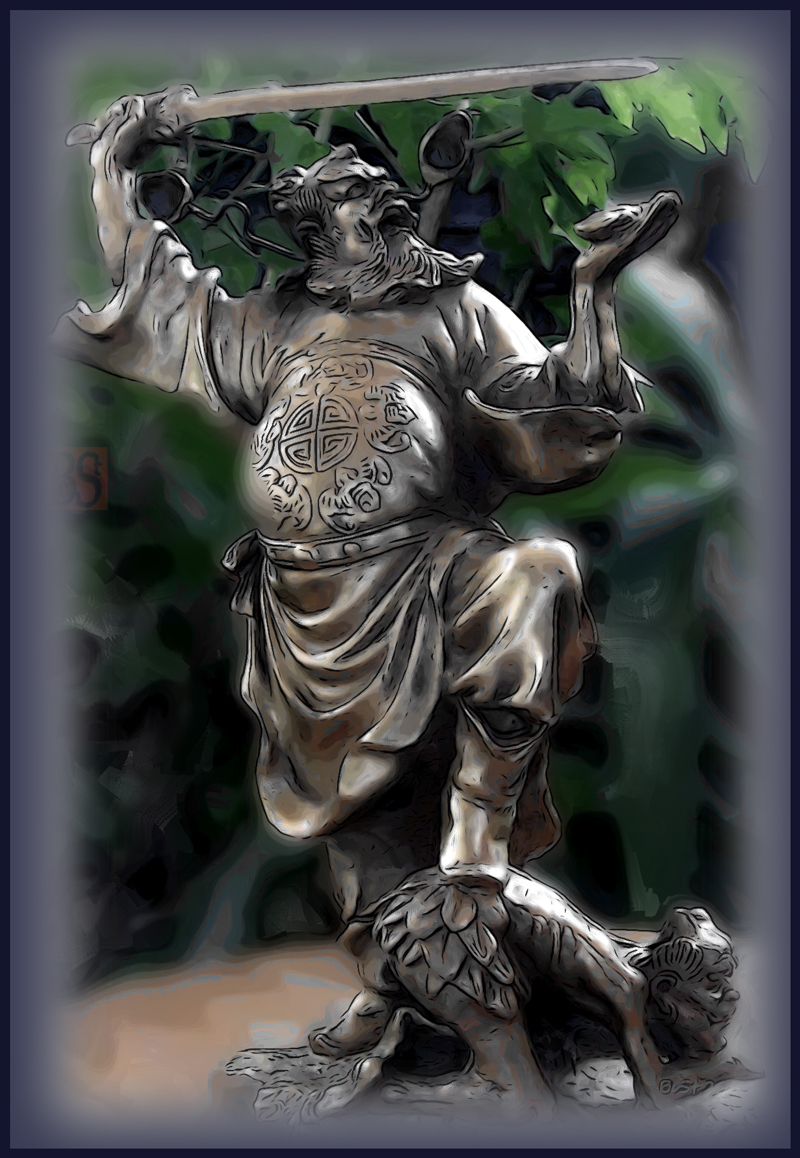
One of the best ways to protect yourself is to have the image of Zhong Kui . 


Zhong Kui


Zhong Kui is a most potent protection from evil spirits, demons and hungry ghosts. Here’s why:

Zhong Kui ( also known as Chung Kwei, Chong Kwei, Chung Kui, Chong Kui, Zhong Kwei, Zhung Kwei, Zhung Kui and Shoki,) is a figure of Chinese mythology. He is traditionally regarded as the vanquisher of ghosts, hungry ghosts and evil spirits. He is purportedly able to command 80,000 demons. His image is often painted on household gates as a guardian spirit and in paintings or statues are kept in places of business for protection from evil.

The representation of Zhong Kui’s bearded face is usually very dark, if not black. Sometimes his fierce face is enough to ward off any evil spirits which is why some pendants depict it. Often he is shown sporting a sword which he uses for battling demons and evil spirits. He is also represented with a magical fan, which he uses to ward of hungry ghosts or other evil ghouls. He is also seen with a red bat, which is a harbinger of good fortune through scholarly means, as he was a highly learned man when alive. 


According to legend, Zhong Kui had once traveled with Du Ping, a friend from his hometown, to take part in the imperial examinations at the capital. Even though Zhong had succeeded in achieving a top honour in the exams, his title of “zhuangyuan” was stripped by the emperor soon after because of his dreadful and somewhat disfigured appearance. Highly incensed Zhong Kui hurled himself against the palace gate until his skull was broken. His trusted friend Du Ping was there fortunately to provide him with the proper funeral. Meanwhile because of his act of suicide Zhong Kui had gone straight to hell. During his judgement however, the Hell King saw a real potential in Zhong: How Zhong had been intelligent enough to score top honors in the imperial examinations, but wrongly robbed of his inherent right. The Hell King (judge) therefore bestowed on Zhong the title King of Ghosts. He was from then on commissioned to hunt down and capture ghosts and maintain order in the Underworld.


Soon after he became King of Ghosts in Hell, Zhong was granted permission to return to his hometown on Chinese New Year’s Eve, in order to repay Du Ping’s kindness. He did this by giving his younger sister in marriage to Du.

Zhong Kui's popularity in folklore meanwhile can be traced all the way back to the reign of Emperor Xuanzong of Tang China (712 to 756). According to Song Dynasty sources, when the Emperor Xuanzong was gravely ill, he’d had a nightmare in which he saw two ghosts. The smaller ghost stole a purse from the imperial consort Yang Guifei and a flute belonging to the emperor. The larger ghost, wearing the hat of an official captured the smaller ghost culprit, tore out his eyes and ate them. He then introduced himself as Zhong Kui, and stated that he had sworn to rid the empire of evil. Upon waking the Emperor found that he was in good health and that he had made a complete recovery from his ailment. He at once commissioned the court painter Wu Daozi to produce the image of Zhong Kui as he remembered it in his dream and then showed this painting to all the officials. This image stuck and Zhong was represented from then on by this image. 


Wu-Daozi-Painting-Zhong-Kui-(The-Demon-Queller)-In-Red-Ink-Wu-Daozi


There are many other ways to protect yourself during the precarious time of the Hungry Ghosts. Here are some Do’s and Don’ts:

-Do not venture outside alone during the dark hours; furthermore, stay away from quiet paths, as ghosts like to target those who are alone. However, if you must, stay away from the walls. Spirits can inhabit them also. 


- Don’t pick someone up! If you go out for a late night drink and further, happen to meet someone that you really hit it off—and then they suggest heading back to your place, be mindful of the ghost stories you’d heard and be safe.

- Avoid standing or loitering under a tree in the middle of the night —spirits love trees.


- Bad manners aside, restrain from spitting in the street or at a tree.

-Do not stare at candlelight or a lit fire.

- Avoid stepping on or kicking the offerings or the joss sticks left alongside of the road.

- Cover up your forehead at night; always pin or put up your hair as high as possible. Wearing any kind of a hat is a good idea.

- Do not play or loiter at the playground in the middle of the night, particularly the swings.

- Resist staring at an “apparition” if you happen to see one; swiftly look away or calmly walk away with composure.

- Do not be disrespectful or utter funny jokes or comments on any display altar or offering items along the street

- Resist the urge to look underneath the altar table during a prayer session

- Do not shift your gaze from left to right or right to left repeatedly when you sense something akin to an apparition; instead look straight ahead and advance toward your destination calmly.

- Should you detect an unexplained, pleasant or sweet smell ahead or around you, restrain from sniffing it.


- It’s best to avoid using any Dark or Black color manicure at this particular time.

- Do not sit on the first few Front Rows of any performance or entertainment.

- Don’t take photos! It is believed that cameras can capture spirits. Best to resist taking a selfie this night, but if you must, look closely at the picture—you may discover an unwelcome visitor lurking in the frame with you.

- Do not wait around at any Bus Stop after Mid-Night especially past the bus service operating hours

- You mustn’t whistle alone at night; if you detect someone singing when you know you are alone, do not accompany him or her.

- Do not open your umbrella at night, especially red color umbrellas

- It’s not advisable to wear a red color costume with high heels and walk alone at night

- Resist any urge to pick up any unique items found on the street or road. And certainly, do not pick up any coins on the ground. Any dropped coins belong to the two guards of the underworld, “Cow Head” and “Horse Face”—these are the two entities that spirits need to bribe in order to enter the mortal realm.

- No swimming in the pool or lake in the middle of the night; something maybe waiting to pull your legs under


- You mustn’t hang your clothes out in the middle of the night

- Do not answer or respond when someone calls you, especially from behind

- Do not turn around or turn your head when someone unexpected pats on your shoulders in the middle of the deserted street

- Avoid combing your hair in front of the mirror in the middle of the night

- Do not be rowdy; best not to shout or scream in the middle of the night. Remain as quiet as possible, particularly if you should feel a sudden, unexplained coldness or temperature drop.

- You mustn’t’ be emotional and cry in the middle of the night

- Resist being a curious person or playing the hero if you hear some "strange" sound or noise, especially a soft crying tone.

- Do not leave any fresh or bleeding wounds out in an open air; always cover the injury/ lesion with proper bandage materials.

- And finally, never respond to a dare or take up the challenge to enter a cemetery area or abandoned houses.


Last but not least there is a legend depicting two images of phantasmal beings/deities you see a lot of around this time. 


-Black-and-White-Impermanence


The Taoist Grim Reapers


For all during Hungry Ghost time, one may encounter images or accounts of two phantasmal beings. They are the “hak bak mo seung” , which means, the “Black and White Impermanence.” (“Impermanence” the Buddhist doctrine of mutability, which states that nothing is inert and that all things must transform—in particular, our lives.)

This pair of deities is believed to guide the spirits of the recently deceased to the underworld. The Black Guard has domain over the evil souls; while the White Guard guides those who have been good in life. The White Guard wears a hat is inscribed with the phrase “yat geen fat choi” which means, “Fortune at one glance”; the Black Guard’s hat has words “teen ha tai ping” which translates as, “Peace under heaven”. The tablet he holds is a symbol of authority, engraved with the character ling, meaning “Order”. The two are often depicted with long red tongues, to scare away evil demons.

There are of course various interpretations to this story. Nevertheless, they all share a common theme: loyalty!

Xie Bian and Fan Wujiu were once two policemen in Fuzhou. Respected by all, they saw each other as nothing less than brothers.

One day, the pair was ordered to track down an escaped convict, who had absconded during a torrential rainstorm. The pair ventured out into the violent gusts and pelting rain; they searched far and wide, leaving no stone unturned, but all to no avail. At one point as the downpour had increased in intensity, they decided to split up and each search one half of the city. They’d arranged to meet, at the end of the search, under a specific bridge in the middle of town.

Fan Wujiu made it to the bridge first, but Xie Bian was held up chasing the fugitive. As the waters rose, Fan refused to leave his spot under the bridge, certain that his brother would arrive soon. He remained even as the floodwaters crashed down on him, and so Fan drowned, tragically, just minutes before Xie showed up. In his anguish, for unwittingly causing the death of his brother, Xie, right there and then took his own life.

Observing this feat of true fidelity, the Jade Emperor raised the two policemen to Godhood, and put them in charge of guiding spirits to the afterlife. Never again would a soul be left standing, waiting for help to arrive.


Good Luck.


The End.