Showing posts with label fable. Show all posts

Saturday, 8 November 2025

GARGOYLES AND GARGOUILLE (DRAGON)

GARGOYLES AND GARGOUILLE (DRAGON) 


Halloween festivities have just ended, during which time we had been mercilessly bombarded with all that was dark, ominous and scary. This was the time when ugly was beautiful and fear mongering was the norm.

My thoughts during this period had naturally turned to a varied, yet common motif donning, mainly historical buildings of most western metropolises, Toronto being no exception. Blissfully unaware we all go about our daily business under the protective gazes of grotesque gargoyles. Yes, gargoyles; but Gargoyles are actually the good guys for they are said to frighten off and protect those structures, old buildings or churches from any evil, harmful spirits.


About AD 631-641, a colourful French legend had sprung up about St. Romanus (“Romain”). In this the former chancellor of the Merovingian king Clotaire II who was made bishop of Rouen, recounted the tale of how he’d delivered the country around Rouen from a diabolical monster called Gargouille or Goji.

The description of La Gargouille pegged him to be a typical dragon, with bat like wings, long neck, and the ability to breathe fire from its mouth.  At that time this dragon had engendered much fear and perpetrated much destruction with its fiery breath. Spouting water, he supposedly devoured men and ships whole.


Each year, the residents of Rouen were forced to placate Gargouille with an offering of a victim, usually a criminal, though it was said that the dragon much preferred maidens.  St. Romanus promised to deliver the townspeople from this terrible danger and in recompense they would all be baptized and later construct a church. 

It is natural to have multiple versions of such a popular fable: In one scenario, St. Romanus purportedly subdued the creature using a crucifix and led the then docile beast back to town on a leash made from his priest’s robe. In another version St. Romanus captured the beast with the help of the only volunteer, a condemned man.

In both cases the monster was led back to Rouen and burned, but only partially. You see the head and neck, being tempered by its own fiery breath, could not be incinerated. Undaunted, the head of Gargouille was still utilized for protection and was promptly mounted on the wall of the newly built church to scare off evil spirits.

Since then, in commemoration of St. Romain, the Archbishops of Rouen were granted the right to set a prisoner free on the day that the reliquary of the saint was carried in procession.

Gargoyles were viewed in two ways by the church; the primary use was to convey the concept of evil through the form of the gargoyle. Some medieval clergy viewed gargoyles as a form of idolatry, for example, in the 12th century St. Bernard of Clairvaux was famous for speaking out against gargoyles. Also, gargoyles were said to scare evil spirits away from the structure, thereby reassuring the congregants that their church was a safe haven from evil spirits.

On the practical side, Gargoyles serve another vital purpose in architecture. Usually an elongated, granite beast with a spout, was designed to direct the flow of rainwater off of the roof. A trough, cut in the back of the gargoyle (the length of the gargoyle determines how far water is thrown from the wall) directed rainwater to exit through the open mouth. Ingeniously therefore, the damaging rainwater was also steered away from the masonry walls and the mortar between to prevent erosion.


Gargoyles had their humble beginnings in the form of fountainheads. The ancient Egyptians, Greeks, Etruscans and Romans fancied these animal configured waterspouts. The term gargoyle was most often applied to medieval work, but throughout history some means of water diversion, when not conveyed in gutters, were adopted. In ancient Egyptian architecture, gargoyles showed little variation, typically carved in the form of a lion's head. Similar lion-mouthed waterspouts were also seen on Greek temples, modeled in the marble or terracotta cymatium of the cornice.


Many medieval cathedrals included gargoyles and chimeras. Although most had grotesque features, over the years the term gargoyle had come to include all types of images. Some gargoyles were depicted as monks, or as combinations of real animals and people, many of which were humorous. Unusual animal/human hybrids, or chimeras, did not act as rainspouts and are more properly called grotesques. They served more as ornamentation but are now synonymous with gargoyles.

Both ornamented and unornamented waterspouts projecting from roofs at parapet level were a common device used to shed rainwater from buildings until the early eighteenth century. After that time more and more buildings installed drainpipes to carry the water from the roof gutters to the ground and only very few buildings using gargoyles were constructed. This was because some people found them frightening and sometimes heavy ones were eroded and fell off, causing damage.

In 1724, the London Building Act passed by the Parliament of Great Britain made the use of downpipes compulsory on all new construction spelling the general demise of Gargoyles and relegating them to place in history and fable.


Still Gargoyles are popular as ornamentation on distinctively styled modern buildings. There they not only live but also thrive, frightening and fuelling the imaginations of new generations.

THE END


Tuesday, 29 April 2025

THE FIGHTING CRICKET (Revised 2025)


THE FIGHTING CRICKET 

(Revised 2025)


In the reign of Hsuan Te in the Ming Dynasty, cricket fighting was a popular entertainment in the court.


At that time a poor scholar, Ch'eng Ming, was given the task of procuring crickets for the court. Ch'eng had no money to buy crickets from his neighbors, and he didn't want to beg, so he became very anxious. His wife advised him, “It’s useless to worry. Why don't you go out and hunt for the crickets yourself?"

So, Ch'eng went out with a copper-wired cage, and from morning to night, he searched among the rugged rocks and the weeds. Sometimes he would catch two or three crickets, but they were always too weak to submit to the local government.

When the date for submitting the crickets arrived, Ch'eng had none, and the magistrate gave him a sound whipping. Ch'eng's legs were so sore that he wanted to die.

Meanwhile, Ch'eng's wife went to a fortune-teller who told her to hunt for crickets at a temple near the village, so she urged Ch'eng to get out of bed and resume his search. Ch'eng, leaning on a cane, went to the temple and at last he caught a fine cricket. He brought it home and waited for the magistrate to call for a cricket.


Ch'eng had a nine-year-old son. One day he opened the cage when Ch'eng was away, and the cricket jumped out. The boy tried to catch it but broke one of its legs and soon it died.

Ch'eng's wife turned ashen when she saw it, she cried, “Beast! Troublemaker! Your father will finish you when he comes back!"The child rushed out of the door in tears.

When Ch'eng returned home and found out what had happened, he flew into a rage, but the boy was nowhere to be found.

Ch'eng searched for half a day and finally found his son's body at the bottom of a well. His anger turned to grief, and his wife prepared to bury the child. But that evening, as they undressed the body, they found it warm to the touch. The boy was alive! They put him to bed, but he remained unconscious.

Ch'eng was very anxious, staying awake the rest of the night to take care of the sick child. At dawn, he heard the chirp of a cricket outdoors. He went out and there was a cricket that looked very much like the one he had lost.

The little insect hopped away from him, and then he found it crouching on the wall. Very small and brownish black, it seemed so feeble that Ch'eng lost interest, but suddenly the insect jumped on his sleeve, and he saw it was actually a very fine insect.


To test its abilities, Ch'eng decided to let it fight with a champion cricket raised by his neighbour.

They put the two insects into a bowl, and Ch'eng's cricket stayed motionless. Then, the neighbour burst into laughter and tickled it with a hog's hair

This aroused the little cricket, and it rushed ferociously at the champion and would have destroyed it if the owner had not removed it. Ch'eng was delighted and didn't notice as the little cricket leapt out of the bowl. Suddenly, a rooster came along and snapped up the cricket.


Ch'eng turned pale, but the rooster stretched its neck, screamed and fell to the ground, for the cricket had bitten its comb.

Ch'eng was overjoyed and quickly put the little insect back into its cage.

The next day Ch'eng gave the cricket to the local government. The magistrate saw the size of it and bitterly scolded Ch'eng, but Ch'eng told him about the rooster, and then the cricket displayed its ferocity. Impressed, the magistrate sent it on to the governor.

The governor put the insect in a golden cage and sent it to the emperor along with a report on its unusual quality. The emperor was doubtful but let it fight with various specimens from other places, all of which were defeated.


The emperor was pleased and rewarded the governor with horses and silk clothing. The magistrate was also rewarded and in gratitude, he released Ch'eng from his duties.

Ch'eng's son did not regain consciousness until a year later. When he awoke, he told them he had dreamt he was a cricket, and that he had fought in the emperor’s palace with many famous champions and defeated them all.


Monday, 1 October 2018

Laoshan Taoist

Laoshan Taoist


(Chinese Classic Revised by BoSt) 


Once upon a time there was a young scholar named Wang Ch'i who was fervent about Taoism and so read every available book and practiced daily to be an ardent Taoist. Somewhere along the way he’d learned that there were many immortals living on Mount Laoshan, so he undertook the long arduous journey there. When he reached the summit of the mountain, true enough he spotted a secluded monastery nestled in the woods. 


 He raced towards it as fast as his feet could carry him and pounded on the large door. As no one responded, he tried the latch and found the door was not locked. He hesitantly let himself in and when his eyes adjusted to the dim light he saw some ways in a distinguished Taoist priest with white hair hanging down to his shoulders who appeared to be in a deep contemplation sitting on a rush mat. Approaching tentatively, Wang kowtowed to show his respect and knelt before the priest in silence in order to compose his thoughts and allow the priest to respond to his presence. As the latter seemed impervious to Wang’s presence and no response was forthcoming, Wang cleared his throat then again kowtowing begged forgiveness for his intrusion then voiced his innermost desire to learn more of Taoism and asked the priest to be his teacher.

The priest’s eyelids slowly lifted and his pupils gazed straight at Wang for a seemingly endless time. His astute observation revealed that Wang, however sincere, was still too pampered to endure all the required hardships to be a proper Taoist. This simply put, failed to deter Wang. He was adamant and emphatically argued that he could adapt and learn new ways, being most willing to endure any hardship to do so. Therefore he was provided with meager living accommodations and was allowed to remain in the monastery for a time, depending on his progress. 


Early the next morning, the priest sent for Wang. He was given an ax and told to go with the other disciples to cut firewood in the forest. Wang happily obeyed. After more than a month of cutting wood however, Wang's hands and feet were covered with thick calluses. The sparse living conditions and the rigid schedule, the enforced quiet, to say nothing of the simple rations eventually took its toll on Wang. Unable to stand the suffering any longer, he began entertaining the idea of returning home. 


One evening, when he returned from his assigned task, he discovered two guests drinking wine with his master. It was already dark, so the priest cut a piece of white paper in the shape of a round mirror and stuck it on the wall. Instantly, it turned into a brilliant white moon which lit up the room. 


The few other disciples streamed in order to wait upon their master and the guests; however one of the guests, not standing on ceremony went forth, took a jug of wine and offered it to the disciples to drink. The jug was passed around accordingly, but the disciples were astonished to see that the wine in the jar did not diminish even after several rounds of consumption.

The other guest said:"It is rather dull drinking by ourselves. Why not ask the moon goddess to join us?" The priest nodded, then he threw a chopstick at the moon on the wall and a beautiful girl appeared. Less than a foot tall at first, she stepped down from the wall and grew to human size. She then proceeded to sing and dance gracefully. 


When she finished singing, she jumped onto the table and turned back into a chopstick. The three quests laughed heartily. They talked, joked around and drunk some more, enjoying a truly pleasurable time. Afterwards one of the guests said:"It has been a very pleasant evening. Will you all drink another glass with me in the Moon Palace?"The three guests ascended and in a flash they disappeared, seeming having moved their table up into the moon. 


Wang rubbed his eyes in disbelief at these phantasmal events. He looked up and strangely enough actually spotted the three figures drinking on the moon, their images completely vivid as though reflected in a mirror. 


After a while, the moon slowly dimmed. One of the disciples brought a lit candle and they saw the priest, once more manifest in the room sitting alone and the two guests gone. The remains of the meal were still on the table and the mirror like paper was still on the wall.

"Have you all had enough to drink?"The priest asked his disciples."Yes." they answered. The priest told them to go to bed early, so they wouldn't be late for their wood-cutting the next day. Full of wonder, Wang thought no more of leaving. 


Another month passed. Once again Wang found it hard to endure the daily grind and all that hardship, but he stubbornly refused to relent, for the priest still hadn't taught him any magic. One day Wang again approached the priest with his request:"I have been here for several months already. All I do is get up at daybreak to cut firewood and return at sunset. I never bore such hardship when I was at home."

"I predicted you wouldn't be able to stand it,” interjected the priest smiling, "You may as well go home tomorrow morning." 


Wang had a stubborn streak and would not give up so easily however, so he pleaded with the priest to teach him some small trick, any trick, to make it all worthwhile.

"Which one then?" asked the priest; nodding.

Wang had noticed that the priest could walk through walls and said that he would be content to know how to do that. The priest smiled and agreed. He taught Wang the spell and bade him to repeat it so he could walk through the wall. At first, Wang was hesitant; he dared not to make the bold move. “What if he got stuck inside the wall?” He envisioned horrifying images, with his head stuck outside or a foot while the torso was trapped within. The priest anticipating his fear smiled reassuringly and voiced his encouragement anew for him to try anyhow. Refusing to be a coward, Wang did as he was told and lo and, behold, passed through the wall unhindered. “Ye!!!!” Elated he turned around but he found himself outside the wall. 


Overjoyed, Wang raced around and went back in to thank the priest. The priest told him to be serious and not misuse the spell when he got home; otherwise, it wouldn't work. Wang promised to remain vigilant and thanked the priest for his instructions. Shortly after he took his leave and descended the mountain. 


When he got home, Wang boasted that he had met an immortal and learnt the art of passing through walls. His wife refused to believe him, so Wang repeated the spell the priest had taught him, backed away a few feet from the wall and ran straight at it.

Thugg!!! He hit his head hard at the wall! 


To Wang's surprise, the spell had lost its magic. He banged his head against the wall again and again, failing each time, and collapsed disoriented and almost unconscious, flat on the ground. When he got up a big bump, the size of an egg, started to swell up on his forehead.

His wife could not help herself and was doubled over with laughter. Wang’s face fell then grew dark, as he was consumed by shame and rage. Gnashing his teeth he inwardly cursed the old priest for his ingratitude and for the perceived betrayal.

Days and month’s passed with Wang incensed at the priest. Eventually reason took hold and he understood what had happened. With humility and longing he anew undertook the journey to visit the monastery. He followed the same paths and searched every corner of the mountain summit, all however without avail; for there was no trace of either the monastery, or the priest or the many novices.

Eventually he gave up and went back home but he was never the same. Often he would be seen as sitting outside in the garden, silent and staring at the moon. On occasion he would raise a cup to the moon and utter a silent prayer or a wish. 


The End

Sunday, 18 September 2016

THE LOST DAUGHTER LEELINAU


THE LOST DAUGHTER LEELINAU


(Original story: The Indian Fairy Book
From the Original Legends
Author: Cornelius Mathews)


Rewritten by BoSt


A long time ago a mighty hunter and his family lived in a modest dwelling alongside the lake near the base of the lofty highlands called Kaug Wudjoo. His favorite daughter, named Leelinau, was a beautiful girl who from the earliest age seemed sensitive, thoughtful, and imaginative. Being rather introverted, she unfortunately, passed much of her time in solitude, preferring nature and the company of plants, birds and animals to that of humans.


Whenever she could, she snuck out of the lodge and sought the remotest recesses of the woods. There was one particular section that had an irresistible draw and, oftentimes, she would sit in lonely reverie there upon some high promontory of rock overlooking the lake. Manitowok (otherwise known as the Sacred Wood) was truly an enchanting place. Resting there amid all the leafy haunts of forest pines, she lent an ear to the melodious ripples of the waves lapping against the open shore. This hallowed ground was of course shunned by all others who feared they might fall under the spell of its mystical inhabitants: the little wild men of the woods, the turtle spirits, or plant fairies that were believed to be consistently frolicking in mischievous revelry. 


So fearful were some of the common folk that, whenever they were compelled to make a landing on this sacred coast, they always left behind an offering or token to appease any ill will and ward off malevolence from the indigenous fairy folk.

Leelinau, being the pure spirit of youth, had no such fear or adverse experience despite the many times she visited this place. She had no qualms visiting this enchanting place that welcomed her and made her feel as though she belonged.

Leelinau began finding her way here from a very young age. She would often go missing for many hours at a time as she gathered strange flowers and plants. Upon her safe return, she presented these delightful gleanings to her parents along with intriguing accounts of all her adventures that had transpired in her rambles. 


Although her parents harbored a secret worry about her frequent visits to this sacred ground, they were unwilling to prohibit it to her, or even in any way deter her from going there. She’d always been very gentle and delicate in temperament and nature; therefore, they could not openly articulate their opposition for fear of making her sick; and so her visits to Manitowok persisted as she grew up in years to early teens.

Oh, but how she loved sitting in her favorite spot with her face turned upward, gazing at the sky or at the languid, shimmering ripples on water. Often she would linger long in contemplation, as though in communion with her guardian spirit seeking divine guidance and solace. Sometimes she would beseech the spirit to lighten her soul and alleviate the sadness that seemed of late to grip her heart. On other visits she would solicit the spirits to procure pleasant dreams or other innocent maiden’s favor. 


On occasion, when her father remained afar on the hunt later than usual, and it was feared that he could be overwhelmed by a tempest, or encountered some misfortune, Leelinau would fast and then spend time in contemplation and a prayer in Manitowok while she implored the spirits’ help to speed his safe return.


As the years advanced, she, now an exquisite beauty in her mid-teens, frequented the fairy pines at greater length and, on her return appeared even more absorbed by it. Her increasingly strange detachment from the accepted norm greatly concerned her parents who began suspecting that some evil spirit had enticed her into its clutches, and had cast upon her a charm which she had not the power to resist.


This belief was confirmed when, one day, Leelinau’s mother, rising at dawn, secretly trailed her daughter into the woods. There, concealed by a huge trunk, she overheard her daughter, quietly seated at a rock, murmuring to some phantom companion, with appeals such as these:

“ Oh spirit of the dancing leaves!” whispered Leelinau, her heart palpitating with intense emotion. “Dear, sweet and gentle specter of the foaming stream. do not forsake me but visit thou my nightly pillow once more, shedding over it silver dreams of mountain brook and pebbly rivulets. Spirit of the starry night; lead my foot-prints to the blushing, burning passion-flower that shines with a carmine hue. Spirit of the greenwood plume,” she concluded, turning with passionate gaze to the beautiful young pines which lightly swayed their green leafy limbs over her head, gently brushing her face “ embrace me, your Leelinau, with thy intoxicating perfume, liken to the ones spring unfolds from its sweetest flowers, or hearts that to each other show their inmost adoration. I entreat you to hear this maiden’s prayer!” 


Gradually with the passing of each day these strange communions with the phantom beings stole the heart of Leelinau away. Now she appeared detached and walked among her people in quiet melancholy, as though she was a passing spirit not belonging to that world. And this was not all, for she grew gradually more remiss with her daily routines, failing to complete even the simplest tasks of the lodge.

Before this time she used to frolic and engage in joyful interactions and play with her young companions as the girls of the neighboring lodges all assembled as usual before the lodge-door to participate in their favorite games of block and string. In contrast Leelinau would sit vacantly, dismissing these pastimes as trivial, unworthy of her attention, or she would feebly make the effort to join if only to articulate her thoughts that this activity was rather irksome to her.

Moreover, on those warm evenings when she was compelled to join in the group of young people as they formed a ring around the lodge and the leather and bone passed rapidly from one to the other she handed it along offhandedly with dispassionate indifference about winning.


Eventually summer turned into autumn and there came the joyful time of the corn harvest. The air was permeated with excitement as all members of the tribe congregated to participate in harvesting the ripened maize from the fields. They had not been at this long when one of the girls, coincidentally the one noted for her beauty, joyfully cried aloud having found a red ear. Everyone rushed over at once to congratulate her for this rare and most fortunate find; for it foretold a brave admirer who would soon be on his way to her father’s lodge. The girl blushed as crimson as the corn and, tucking the trophy to her bosom, awkwardly intoned her thanks for their well wishes then inwardly offered her sincere gratitude to the Great Spirit that the red ear was straight and true rather than being crooked and bent.


Just then one of the young men noted Leelinau’s unease as she stood aloof off to the side and, on looking more intently, spied in Leelinau’s hand another red ear she had just plucked, but this one was crooked. At once the word “Wa-ge-min!” rang out from him and the whole gathering gave a loud roar.

“The thief is in the corn-field!” shouted the young man, whose name was Lagoo and who happened to be a mischievous person well-known in the tribe for his mirthful powers of story-telling. “Beware all! Watch out for the old man stooping as he enters the field. Watch out for the one who crouches as he creeps in the dark. Is it not plain enough by this mark on the stalk that he was heavily bent in his back? Old man, be nimble or someone will take thee while thou art taking the ear.” Lagoo continued in his exaggerated tones, accompanying his words with the mimicked action of one bowed with age stealthily entering the corn-field. “See how he stoops as he breaks off the ear. Nushka! He seems for a moment to tremble. Walker, be nimble! Hooh! It is plain the old man is the thief.” He turned abruptly and, facing Leelinau as she sat in the circle, pensively regarding the crooked ear which she held in her hand, and then loudly screeched, “Leelinau, the old man is thine!”

Rounds of laughter rung merrily through the corn-field, but Leelinau, casting the crooked ear of maize down upon the ground, simply walked away without a word.

The subsequent morning at dawn the eldest son of a neighboring chief called at her father’s lodge. He was quite advanced in years; but he enjoyed such renown for his aptitude, dexterity and courage in battle, to say nothing of his expertise in the hunt, that Leelinau’s parents accepted him at once as a suitor for their daughter. They also held the firm belief that it must have been the chief’s son whom Lagoo had pictured as the corn-taker. Their decision was also based on the dire hope that he, with his proficiency as a warrior, would perhaps win back the affections and thoughts of Leelinau from the harmful phantoms in the spirit-land.

Leelinau did not express any objections to his age or give any other plausible reason; she simply shook her head in the negative, clearly rejecting his proposal. Her parents spent the night arguing the point between them. By the following day, with their mind set, ascribing the young daughter’s hesitancy to maidenly fear, they went ahead anyway and fixed the date for the upcoming nuptials.

Knowing her daughter’s whims better, Leelinau’s mother harbored a secret worry that she kept from her husband. She chose to busy herself for the next couple of days with the customary preparations, refusing to deal with the nagging question that haunted her peace: The marriage-visit to their lodge, when the old warrior would present himself at the door was arranged and the day was fast approaching. What if Leelinau refused to admit him? She’d already definitely informed her parents that she would never acquiesce to this match. Would she relent?

They had no way of knowing of course that in her heart of hearts Leelinau had already avowed fidelity to another. 


When she was much younger she had confessed to her mother some, but not all, the details. The fancies that filled her young mind during all those absentee hours spent under that broad-topped young pine whose leaves whispered in the gentle murmur of the air in the evening hours when the twilight steals by with night on its heels.


During one of those times while reclining pensively against the young pine-tree, she’d fancied that she had heard a voice addressing her. At first it had been scarcely more than a sigh, but gradually it had grown more pronounced:

"Sweet maiden,” Said the melodious whisper. “Pray think of me not just a tree; but as one who is fond to be with thee; I, with my tall and blooming strength, with my bright green nodding plume that wave above thee. Thou art leaning on my breast, Leelinau; lean forever there and be at peace. Fly from men who are false and cruel, and quit the tumult of their dusty strife and instead embrace this quiet, lonely shade. Over thee my arms I will always spread, sturdier than the lodge's roof. I will breathe a perfume like that of flowers over thy happy evening rest. In my bark canoe I'll waft thee o'er the waters of the sky-blue lake. I will deck the folds of thy mantle with the sun's last rays. Come, and on the mountain free rove in bright Fairy with me!"


These riveting, enchanting words were drunk in with an eager ear by Leelinau and in time the tiny buds of love in her heart transformed into full blossoms. 


Her mind made up, she’d sworn then and there to forsake all other. Returning to the spot time after time, she’d listen with intent to hear more but the voice became only an inaudible murmur and then it had ceased altogether. Even so, she felt such solitude and peace there. Meanwhile in her heart the hope persisted and flourished with a sure conviction that one day, one day, it will be so.


On the eve of the day that was fixed for her marriage, Leelinau donned her best garments. She arranged her hair according to the tradition of her tribe, and wore all her maiden ornaments in beautiful array. With a smile, she then came forth and presented herself to her parents.

“I am sorry to have caused you so much worry,” She said, “It is time for me to now to take my leave of you. My place is with the chieftain of the Green Plume, who is waiting for me at the Spirit Grove.”

Her face was radiant with joy, and the parents, taking what she had said as her own fanciful way of expressing acquiescence in their plans, and of her intention to have a clandestine meeting with her intended suitor, wished her good fortune in their happy meeting.


"I leave you with some trepidation in my heart," she continued, addressing her mother as they left the lodge, "Joyful as this event is, my heart is beset with sadness for I am going from one who has loved and nurtured me since my infancy; one who has guarded my youth; who has given me medicine when I was sick, and taught me to cook and sew.” Turning to take one last teary eyed look at the lodge, she added. “I am going from a father who has ranged the forest to procure the choicest skins for my dresses, and kept his lodge supplied with food and warmth. He kept us all safe from all danger. I am going from a lodge which has been my shelter from the harsh storms of winter, and my shield from the heat of summer. My gratitude is boundless for all that you’ve both done for me. But now I must leave you. Farewell, my beloved mother, my respected father, farewell!"


So saying, she sped faster than any could follow to the margin of the fairy wood, and in a moment she was lost to sight.

As she had often thus taken her leave of the lodge with such sentimental and solicitous words, her parents opted not to worry but instead confidently awaited her safe return. Time passed. Hour followed yet another hour, as the clouds of evening rolled up in the west; darkness came on, but no daughter returned. 


They jumped from their seat at a loud knock on the door and rushed to open it. But instead of Leelinau, they came face to face with the forlorn and decidedly angry face of the bridegroom who demanded an explanation for this insult. Soon, armed with torches, they hastened to the wood in search of Leelinau. Although they lit up every dark recess and probed each leafy gloom, their search was in vain. Leelinau was nowhere to be seen. In lamentation they called her name, but she answered not.


Many suns rose and set, but nevermore in their light did the bereaved parent’s eyes behold the lost form of their beloved child. Soon they had to come to grips with a harsh reality: their beloved daughter was lost to them forever. Wherever she had vanished, it was to a place no mortal eyes could see and no mortal tongue could tell. 


Some years later however, it chanced that a company of fishermen, who were spearing fish in the lake near the Spirit Grove, saw an apparition. Back in the village they excitedly descried their encounter as they sat by the fire under the moonlight night; how they had spotted, only for an instant, an enchantingly beautiful apparition resembling a female figure clad in flowing, flowery garments standing on the shore. As the afternoon was mild and the waters calm, they had cautiously pulled their canoe in toward the bank, but the slight ripple of their oars invoked alarm. The phantom beauty had fled in haste, but not before they recognized in the shape and dress as she ascended the bank, the lost daughter, and they saw further her most handsome fairy-lover, green plumes waving over his forehead as he glided lightly through the forest of young pines.


The End.

Friday, 9 May 2014

THE ORIGIN OF THE ROBIN

The Origin of the Robin


After a long drawn out winter, spring is finally making a comeback here. Tender new shoots are poking their heads hither and thither through the brown debris as if just awakening. Rain showers abound, worms are crawling their way through the depths of the soil providing nourishment to robins. 


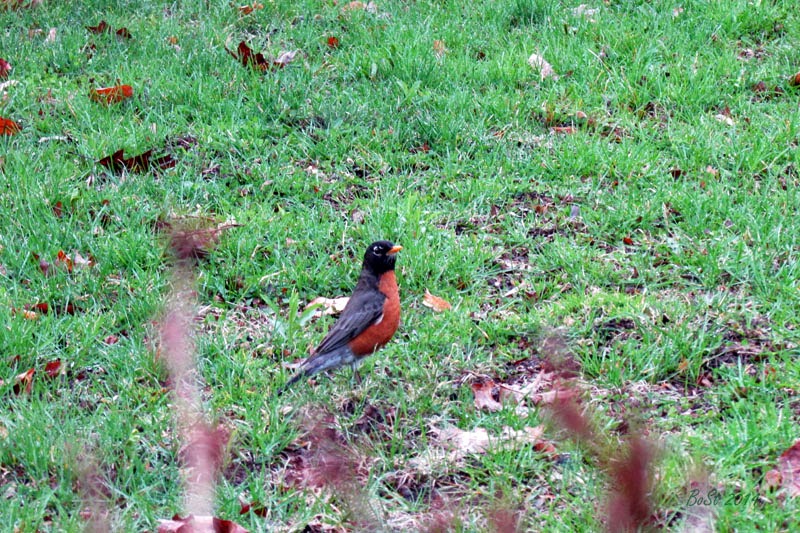
Robins are birds with brown backs and a reddish-orange breast which varies in colour from a rich red maroon to peachy orange. You often see those tugging earthworms out of the ground, which is a sure sign of spring.


 The robin’s head varies from jet black to gray, with white eye arcs. The throat is white with black streaks and the belly and under tail coverts are white as well. The bill is mainly yellow with a variable dark tip, the dusky area becoming more extensive in winter, and the legs and feet are brown.


We all notice them because of their distinct appearance and cheery songs. The male robin, as with many thrushes, has a complex and almost continuous song. Its song is commonly described as a cheerily carol, made up of discrete units, often repeated, and spliced together into a string with brief pauses in between. The song varies regionally, and its style varies by time of day. The robin is often among the first songbirds singing as dawn breaks and the last as the evening sun sets. It usually sings from a high perch in a tree. In addition to its song, the robin has a number of calls used for communicating specific information such as when a ground predator approaches, and when a nest or the robin is being directly threatened.


The American robin is a migratory songbird of the thrush family. It is named after the European robin because of its reddish-orange breast, though the two species are not closely related, with the European robin belonging to the flycatcher family. According to some sources, the American robin ranks behind only the red-winged blackbird (and just ahead of the introduced European starling) as the most abundant land bird in North America. Robins breeds throughout most of North America from Alaska and Canada southward to northern Florida and Mexico. While robins occasionally overwinter in the northern part of the United States and southern Canada, most migrate to Florida and the Gulf Coast or to central Mexico, as well as the Pacific Coast. 


The lone robin is active all through the day and assembles in large flocks at night. Its diet consists of invertebrates such as beetle grubs, earthworms, and caterpillars, fruits and berries. It is one of the earliest bird species to lay eggs, beginning to breed shortly after returning to its summer range. 


A new nest is built for each brood, and in northern areas the first clutch is usually placed in an evergreen tree or shrub while later broods are placed in deciduous trees. The nest is most commonly located above the ground in a dense bush or in a fork between two tree branches and is built by the female alone. The outer foundation consists of long coarse grass, twigs, paper, and feathers. This is lined with smeared mud and cushioned with fine grass or other soft materials. In urban areas the robin sometimes constructs nests under eaves or awnings on human homes when such locations provide adequate shelter. Robins are not cavity nesters, and so will generally not use a bird house, but will take advantage of artificial nesting platforms that have been provided. Robin's egg blue is a color named after the bird's eggs. 


A clutch consists of three to five light blue eggs, and is incubated by the female alone. The eggs hatch after 14 days, and the chicks leave the nest a further two weeks later. The newly hatched chicks are naked and have their eyes closed for the first few days. While they are still young, the mother broods them continuously and are fed are fed worms, insects, and berries. When they are older, the mother will brood them only at night or during bad weather. Waste accumulation does not occur in the nest because adults collect and take it away. All chicks in the brood leave the nest within two days of each other. Even after leaving the nest, the juveniles will follow their parents around and beg food from them. Juveniles become capable of sustained flight two weeks after fledgling. 


The robin usually uses auditory, visual and olfactory means to seek prey, but vision is the predominant mode of prey detection. It also has the ability to hunt by hearing. It typically will take several short hops and then cock its head left, right or forward as a means to detect movement of its prey.

The Robins can be preyed upon by hawks, cats and large snakes. 


The American robin is a known carrier for West Nile virus. While crows and jays are often the first noticed deaths in an area with West Nile virus, the American robin is suspected to be a key host, and holds a larger responsibility for the transmission of the virus to humans. This is because, while crows and jays die quickly from the virus, the American robin survives the virus longer, hence spreading it to more mosquitoes which then transmit the virus to humans and other species. 


The robin has a prominent place in Native American mythology. The story of how the robin got its red breast by fanning the dying flames of a campfire to save a Native American man and a boy is similar to those that surround the European robin. 


The Tlingit people of Northwestern North America held it to be a culture-hero created by Raven to please the people with its song. One of the Houses of the Raven Tribe from the Nisga'a Nation holds the robin as a House Crest. 


Here’s one of the North American legends: 


The Origin of the Robin


From: The Indian Fairy Book , The Original Legends

Author: Cornelius Mathews


An old man had an only son, named Iadilla, who had come to that age which is thought to be most proper to make the long and final fast which is to secure through life a guardian genius or spirit. The father was ambitious that his son should surpass all others in whatever was deemed wisest and greatest among his people. To accomplish his wish, he thought it necessary that the young Iadilla should fast a much longer time than any of those renowned for their power or wisdom, whose fame he coveted.

He therefore directed his son to prepare with great ceremony for the important event. After he had been several times in the sweating-lodge and bath, which were to prepare and purify him for communion with his good spirit, he ordered him to lie down upon a clean mat in a little lodge expressly provided for him. He enjoined upon him at the same time to endure his fast like a man, and promised that at the expiration of twelve days he should receive food and the blessing of his father.

The lad carefully observed the command, and lay with his face covered, calmly awaiting the approach of the spirit which was to decide his good or evil fortune for all the days of his life.

Every morning his father came to the door of the little lodge and encouraged him to persevere, dwelling at length on the vast honor and renown that must ever attend him, should he accomplish the full term of trial allotted to him. 

To these glowing words of promise and glory the boy never replied, but he lay without the least sign of discontent or murmuring until the ninth day, when he addressed his father as follows:

"My father, my dreams forbode evil. May I break my fast now, and at a more favorable time make a new fast?" 


The father answered:

"My son, you know not what you ask. If you get up now, all your glory will depart. Wait patiently a little longer. You have but three days more, and your term will be completed. You know it is for your own good, and I encourage you to persevere. Shall not your aged father live to see you a star among the chieftains and the beloved of battle?"

The son assented; and covering himself more closely, that he might shut out the light which prompted him to complain, he lay till the eleventh day, when he repeated his request. 


The father addressed Iadilla as he had the day before, and promised that he would himself prepare his first meal, and bring it to him by the dawn of the morning.

The son moaned, and the father added:

"Will you bring shame upon your father when his sun is falling in the west?"

"I will not shame you, my father," replied Iadilla; and he lay so still and motionless that you could only know that he was living by the gentle heaving of his breast.

At the spring of day, the next morning, the father, delighted at having gained his end, prepared a repast for his son, and hastened to set it before him. On coming to the door of the little lodge, he was surprised to hear his son talking to himself. He stooped his ear to listen, and, looking through a small opening, he was yet more astonished when he beheld his son painted with vermilion over all his breast, and in the act of finishing his work by laying on the paint as far back on his shoulders as he could reach with his hands, saying at the same time, to himself: 


"My father has destroyed my fortune as a man. He would not listen to my requests. He has urged me beyond my tender strength. He will be the loser. I shall be forever happy in my new state, for I have been obedient to my parent. He alone will be the sufferer, for my guardian spirit is a just one. Though not propitious to me in the manner I desired, he has shown me pity in another way—he has given me another shape; and now I must go." 


At this moment the old man broke in, exclaiming:

"My son! my son! I pray you leave me not!"

But the young man, with the quickness of a bird, had flown to the top of the lodge and perched himself on the highest pole, having been changed into a beautiful robin red-breast. He looked down upon his father with pity beaming in his eyes, and addressed him as follows:

"Regret not, my father, the change you behold. I shall be happier in my present state than I could have been as a man. I shall always be the friend of men, and keep near their dwellings. I shall ever be happy and contented; and although I could not gratify your wishes as a warrior, it will be my daily aim to make you amends for it as a harbinger of peace and joy. I will cheer you by my songs, and strive to inspire in others the joy and lightsomeness of heart I feel in my present state. This will be some compensation to you for the loss of glory you expected. I am now free from the cares and pains of human life. My food is spontaneously furnished by the mountains and fields, and my pathway of life is in the bright air." 


Then stretching himself on his toes, as if delighted with the gift of wings, Iadilla caroled one of his sweetest songs, and flew away into a neighboring wood. 


The End.